Elysia Xpressor Neo Review
- For recording, mixing and mastering
- Smooth control behaviour due to RMS detector and soft knee curve
- Parallel compression and side chain inputs and outputs
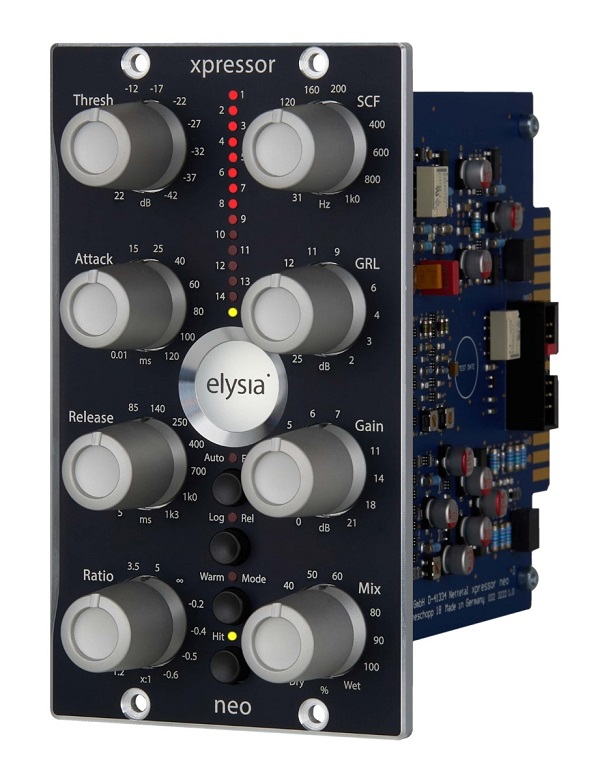
Here we have another amazing unit from a trusted brand. The Elysia xpressor neo is a true stereo Class A discrete compressor in a dual-slot 500 series format, drawing ~120mA across ±16V rails. We’ve found its matched discrete circuitry delivers rock-solid stereo imaging, while Warm Mode introduces harmonic saturation that thickens transients and low-mids.
Auto Fast trigger scaling and logarithmic release curves provide musical envelope control without over-compression. Its onboard wet/dry mix knob enables parallel processing without external routing, and there’s plenty more to unpack below.

What Is the Elysia xpressor neo 500 Series Compressor?
What sets this class a stereo compressor apart is its true stereo architecture, matched discrete circuitry guarantees rock-solid stereo imaging across the entire gain reduction range.
The Class-A discrete signal path eliminates crossover distortion, yielding superior sonic transparency.
As a dual-slot 500 series module, it draws approximately 120mA across +/-16V DC rails, making integration into existing lunchboxes straightforward without taxing your power supply.
Sonic Character and Performance: Surgical Precision Meets Warmth
Engage Warm Mode, and the audio processing character shifts dramatically. A secondary analog circuit rolls off extreme high-frequency content while introducing subtle harmonic saturation, think smoothed transients, weighted low-mids, and a cohesive analog sheen that tames harsh digital stems without dulling them.
On drum buses, it’s transformative: gain reduction feels musical rather than mechanical, adding body and glue.
We’ve found Warm Mode particularly effective on sterile ITB mixes, where that Class-A harmonic richness bridges the gap between clinical precision and vintage analog vibe.

Advanced Envelope Features: Auto Fast and Log Release
| Feature | Behavior |
|---|---|
| Auto Fast Trigger | Transient-dependent attack scaling |
| Auto Fast Benefit | Prevents overs without over-compressing |
| Log Release Curve | Logarithmic recovery shape |
| Log Release Benefit | Punchier, more musical release |
| Combined Use | Flexible dynamic envelope control |
Unlocking Creative Dynamics: Negative Ratios and Parallel Mix
Pairing these extreme settings with the onboard mix control raises parallel processing to hardware-native territory.
You’re blending a heavily crushed, dynamically inverted signal beneath your dry track using a single continuous knob, no external routing required. This 0-100% wet/dry sweep lets you dial precise gain reduction saturation levels, maintaining punch and presence while embedding aggressive compression textures deep within your mix architecture.
Your options here are unlimited. You just need to experiment and find the best possible usage for this great Class A compressor.
- Maximum input level: +22 dBu
- Negative ratio can be generated
- Logarithmic and linear release curves
- Auto Fast function
- Design: API Series 500 format, 2 slots
Sidechain Filter Control and Front-Panel Ergonomics
Front-panel ergonomics reinforce session efficiency. The brushed aluminum faceplate houses detented knobs with precise tactile resistance, enabling repeatable recall without visual confirmation.
High-contrast multi-segment LEDs display gain reduction and output simultaneously, remaining readable across dim control rooms and bright studio environments.
Toggle switches engage features like Auto Fast and Warm Mode with definitive mechanical feedback, no ambiguity mid-take. Every control element prioritizes speed and accuracy during demanding tracking workflows.
Is the Elysia xpressor neo Worth It? (Final Verdict)
Beyond its refined control surface, the xpressor neo‘s real value proposition emerges when we assess its cumulative feature set against the competitive 500-series compressor environment.
No other dual-slot 500-series efficiency package delivers negative ratios, Auto Fast transient management, logarithmic release curves, and 100% parallel mix control simultaneously.
The elysia xpressor neo isn’t merely a 500 series compressor, it’s a stereo buss compression powerhouse engineered for modern stereo VCA flexibility across mixing and mastering workflows.
We recommend the xpressor neo for mix engineers processing drum stems, electronic music producers requiring creative dynamics manipulation, and hybrid studio owners demanding surgical transparency alongside analog warmth.
If you’re seeking a single stereo VCA compressor that scales from invisible gain reduction to aggressive pumping effects, this unit delivers definitively.
Frequently Asked Questions
Q: How Much Power Does the Elysia Xpressor Neo Draw From a 500 Series Chassis?
A: The xpressor neo draws approximately 120mA total across the ±16V DC rails, think of it as a small river feeding a powerful engine. We’d recommend ensuring your chassis can sustain that current comfortably.
Q: Can the Xpressor Neo Fit in a Single-Slot 500 Series Frame?
A: No, it can’t. The xpressor neo requires a dual-slot 500 series frame, occupying two consecutive module bays to accommodate its true stereo Class-A discrete circuitry and matched VCA gain reduction topology.
Q: What Is the Maximum Makeup Gain Available on the Xpressor Neo?
A: The xpressor neo offers up to +21dB of makeup gain via its continuous rotary potentiometer, plenty of headroom to compensate for heavy gain reduction while maintaining that pristine Class-A discrete signal integrity.
Q: Does the Xpressor Neo Require Matched Pairs for True Stereo Operation?
A: No, the xpressor neo already houses matched discrete Class-A circuitry internally, like twin engines sharing one cockpit. We’re looking at a dual-slot 500-series module delivering true stereo processing straight out of the box.
Q: What Voltage Rails Does the Elysia Xpressor Neo Need to Operate Properly?
A: The xpressor neo operates on standard 500-series ±16V DC rails, drawing approximately 120mA total. We’d recommend ensuring your chassis delivers clean, regulated power for ideal Class-A discrete circuit performance.
Conclusion
We’d satirize the xpressor neo’s flaws, but honestly, we’re still searching for them, like hunting for THD artifacts in a Class-A topology that’s cleaner than our cable management.
This dual-slot 500 series unit delivers transparent gain reduction, musically responsive auto-fast attack constants, and that elusive negative-ratio parallel compression nobody asked for but everyone needs.
Picture a compressor so refined it makes your outboard rack feel personally inadequate. We’re calling it: essential.
Related Articles
- Rupert Neve Designs: Big 500 Series Modules!
- Empirical Labs Pump Review: Lovely 500 Series Compressor!
- Radial EXTC-500 Review: Cheap Guitar Effects Interface!
- Lindell Audio 7X-500 Review: Great FET Compressor!
- Little Labs VOG Review: Big Bass Resonance Processor!
- AEA RPQ503 Review: Amazing 500-Series Mic Preamp!
- 500 Series Routing Basics: Important Steps to Consider!
- API 500 Series: List of Great Audio Modules!
- Drawmer OC-1 Review: Great 500 Series Opto Compressor!
- Cloud Microphones True Blue CL-520 Review!
- Trident Audio SC2-500 Review: Big Optical Compressor!