Radial EXTC-500 Review
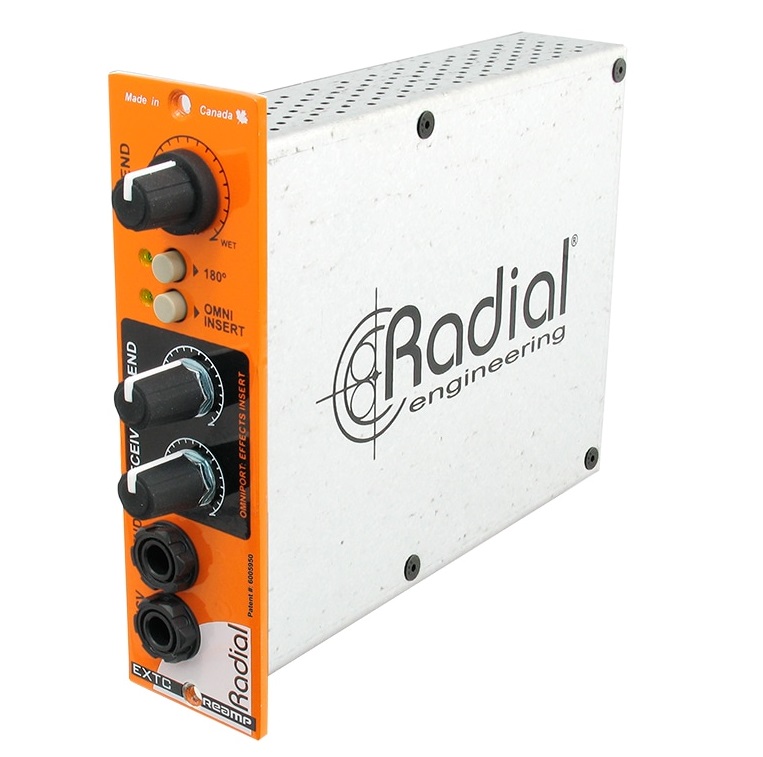
- Balanced reamper
- Send / receive jack
- Send and return separately controllable
- Wet/dry control
Well, now we have something that is not that common, but in time of need, it is a well looked after. The Radial EXTC-500 converts balanced +4dBu signals to hi-Z instrument level, letting you route studio audio through guitar pedals without fidelity loss or ground loop hum.
Its Class-A discrete circuitry and transformer isolation preserve high-frequency detail and dynamics across drums, vocals, and synths. We’ve found the continuous blend knob, polarity invert switch, and independent send/receive gain staging essential for dialing in parallel processing. Below, we’ll break down each feature and its real-world studio impact.

What Is the Radial EXTC-500 500 Series Module?
The Radial EXTC-500 is a single-width 500 series module that converts balanced +4dBu line-level signals down to hi-impedance instrument level (10k-Ohm), routes them through guitar pedals, and returns the processed signal back to balanced line level.
This bridges the impedance gap between pro line-level studio gear and high impedance pedal inputs without frequency loss or signal degradation.
At its core, the EXTC-500 employs Radial’s proprietary Class-A discrete audio circuitry paired with transformer isolation, effectively eliminating ground loops and 60Hz hum across the send/return chain.
We’re looking at approximately 40mA power draw on standard +/-16V 500 series rails, making it efficient within densely populated lunchboxes. The architecture prioritizes transparent signal transfer with minimal noise floor impact.
How Does the Radial EXTC-500 Perform in the Studio?
Beyond architecture and specs, what matters is how the EXTC-500 handles real signal in a mix session. We’ve run snare drums through fuzz pedals, vocals through analog delays, and synths through chorus boxes, each time, the Radial Engineering EXTC-500 preserved high-frequency detail and dynamic response without the typical impedance-related losses.
The transformer-isolated signal path eliminates ground loop hum, letting us push pedals hard without introducing noise. The Send and Receive knobs provide precise gain staging, while the Blend control enables parallel processing that maintains punch alongside effect saturation.
Polarity invert corrects phase issues instantly. For real-world mix applications, this module transforms guitar pedals into a legitimate creative tool for professional sessions, no signal degradation, no compromise. It’s impedance matching done right.
- Balanced interface for guitar effects pedals
- Separate send & receive controls optimize signal path
- Transformer isolated send eliminates ground loops
- Creative tool helps set your mix stand out
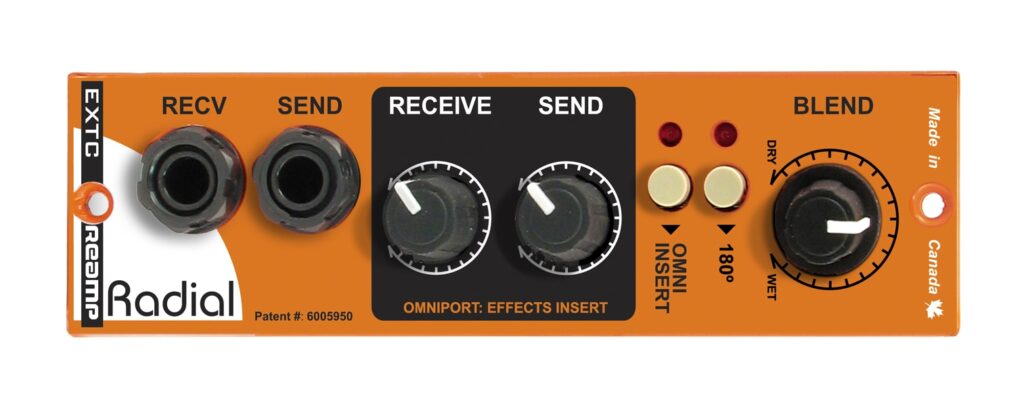
Front-Panel Controls: Send, Receive, and Parallel Blend
The continuous blend knob is where Radial Engineering delivers real mixing utility.
This 0-100% wet/dry parallel processing control lets you tuck heavy distortion or saturated reverb behind your clean transient attack.
The EXTC 500 preserves your dry signal’s punch while layering pedal character underneath, critical when processing drums, vocals, or synths through aggressive effects chains.
Parallel blending only works correctly when wet and dry signals share the same polarity, and many guitar pedals invert signal phase internally by 180 degrees.
When you sum an inverted wet signal with the dry path, opposing waveforms cancel overlapping frequencies. The result: thin bass, hollow midrange, and a mix that loses body as you increase the blend knob.
The EXTC-500’s 180-degree Polarity Invert switch addresses this directly. One flip realigns signal phase between wet and dry paths, restoring low-end punch and full-spectrum coherence instantly.
You’ll hear the difference immediately, bass frequencies snap back, and the parallel blend behaves as intended.
We recommend engaging the switch, listening for increased fullness, then toggling back to confirm. Whichever position sounds thicker is your correct polarity alignment. Phase cancellation solved.
Front-Panel I/O vs. Rear Patching and Omniport Utility
Because the EXTC-500 places its 1/4-inch Send and Receive jacks directly on the front panel, you can swap guitar pedals in and out of your signal chain without crawling behind the rack or disrupting permanent patchbay wiring.
This front-panel access eliminates downtime during mix sessions, letting you audition different effects chains in seconds.
For permanent studio wiring, the rear chassis XLRs handle balanced line-level connections to your console or interface, maintaining clean signal routing through your existing infrastructure.
If you’re running a compatible Radial Workhorse or similar chassis, the Radial Omniport provides an additional connectivity path directly through the backplane, consolidating pedal swapping and signal distribution into one integrated system.
This dual-access architecture separates temporary creative routing from fixed studio wiring, keeping your workflow efficient and your signal path uncompromised.
Is the Radial EXTC-500 Worth It? (Final Verdict)
So is the Radial EXTC-500 worth a slot in your rack? Absolutely. The Radial EXTC is the definitive guitar effects interface for 500 series racks, solving impedance headaches and ground hum through transformer-isolated, pristine circuitry that preserves every harmonic detail.
If you’re a mixing engineer routing vocals through fuzz pedals, a producer blending delay on drum buses, or an electronic music creator processing hardware synths through modulation chains, this module eliminates the technical barriers between instrument-level effects and pro line-level workflows.
We recommend the EXTC-500 for anyone who refuses to compromise signal integrity while exploiting guitar pedals in professional production environments.
Frequently Asked Questions
Q: Can the Radial EXTC-500 Handle Stereo Effects Pedals Simultaneously?
A: No, we can’t route stereo effects through a single EXTC-500. It’s a mono, single-width 500 series module with one send/receive FX loop.
You’ll need two EXTC-500 units to process left and right channels independently through stereo pedals.
Each module handles one discrete signal path: balanced line-level conversion down to Hi-Z, through your pedal, then back to balanced line-level.
Pairing two enables true stereo parallel processing with independent blend control.
Q: How Does the EXTC-500 Compare to the Radial EXTC-SA?
A: We’ve found the key difference lies in form factor and integration.
The EXTC-500 is a single-width 500-series module drawing power from your rack’s ±16V rails, while the EXTC-SA is a standalone desktop unit with its own power supply.
Both deliver Class-A circuitry, transformer isolation, and impedance conversion from +4dBu to Hi-Z, but the 500-series format lets you consolidate signal routing directly within your processing chain.
Q: What 500 Series Chassis Works Best With the EXTC-500?
A: The EXTC-500 works best in Radial’s own Workhorse series chassis, specifically the WR8 (8-slot) or WR5 (5-slot), because they enable the Omniport jack functionality, giving you an additional I/O option directly from the rear panel.
That said, any standard 500-series rack supplying +/-16V DC rails will power it fine at roughly 40mA draw.
We’d recommend prioritizing chassis with robust power supplies to maintain that low noise floor.
Q: Can You Chain Multiple Guitar Pedals Through the EXTC-500?
A: Absolutely, you can daisy-chain multiple guitar pedals between the EXTC-500’s Send and Receive jacks.
Why limit yourself to one? We route the balanced +4dBu signal down to Hi-Z instrument level, feed it through your entire pedalboard chain, then the Class-A discrete circuitry boosts everything back to balanced line level with transformer isolation.
The Blend control lets you dial in parallel processing across your full chain without signal degradation.
Q: Does the EXTC-500 Work With Bass or Keyboard Effects Pedals?
A: Yes, it works with bass and keyboard effects pedals. The EXTC-500’s Send output converts to Hi-Z at 10k-Ohm impedance, which matches any pedal designed for instrument-level input, regardless of whether it’s guitar, bass, or keys.
We’ll use the Send knob to optimize drive levels and the Receive knob to restore balanced +4dBu output.
Transformer isolation eliminates ground loops, so you’re processing cleanly without signal degradation across any pedal type.
Conclusion
We’ve run everything from crushed room mics through a Pro Co RAT to parallel-blended vocal sends through a Boss RE-20 Space Echo, and the EXTC-500 handles every impedance conversion transparently.
The send/receive gain staging, phase invert switch, and wet/dry blend give us precise signal-flow control without ever leaving our 500 series rack. If you’re routing line-level sources through guitar pedals regularly, the EXTC-500 eliminates every technical compromise in that chain.
Related Articles
- Rupert Neve 542 Review: Legacy Tape Emulator!
- Elysia xfilter 500 Review: Pro Audio Stereo Equalizer!
- Chandler tg2 500 Review: 500 Series Microphone Preamp!
- SSL G Bus Review: Great 500 Series Compressor Module!
- Radial Workhorse Cube Review: Amazing 500 Series Chassis!
- Pultec EQP-500X Review: Huge 500 Series Program Equalizer!
- SSL Six 500 Series Review: Big Channel Strip in 500!
- Rupert Neve Designs 511 Review: Amazing Mic-Pre!