Cranborne Audio Carnaby 500

- Enhances your tracks, mixes, and masters with euphonic harmonic saturation
- Optosync feature allows for stereo operation with 2 units
- Convenient 500 Series format
The Cranborne Audio Carnaby 500 is the first harmonic EQ in the 500-series format and utilizes a UK-patented design that replaces conventional parametric filters with tuned harmonic saturation.
It features three bands; a low-shelf with hard clipping (20 Hz-420 Hz), a mid-peak with a fixed Q factor (200 Hz-6.2 kHz), and a high-shelf with soft saturation (5 kHz-25 kHz).
The Input Drive controls the intensity of the saturation, while OptoSync enables wireless stereo coupling between adjacent modules. Below, we’ll break down its signal flow, gain staging, and stereo integration in detail.
What Is the Cranborne Audio Carnaby 500 Harmonic EQ?
How does a single 500-series module reshape the frequency content without conventional filter networks? The Cranborne Audio Carnaby 500 answers this by replacing traditional parametric EQ circuits with tuned harmonic saturation, a UK patent-pending design that generates band-specific harmonics to dynamically shape frequency ranges.
Here, we take a look at the world’s first 500-series Harmonic EQ. Instead of filtering frequencies via boost/cut networks, the Carnaby 500 utilizes analog saturation directly assigned to selected frequency zones.
Precisely graduated detents on each control enable exact session reproducibility, while OptoSync, a wireless optical coupling system, facilitates seamless stereo linking between adjacent modules. Power consumption ranges from 140 mA at idle to a peak of 160 mA on standard ±16 V DC rails, keeping power requirements manageable even in fully equipped chassis.
How Harmonic EQ Works: Saturation-Driven Frequency Control
Why does boosting a band on the Carnaby 500 sound fundamentally different from boosting the same frequency on a conventional EQ? Traditional analog EQ circuits apply gain through phase-shifting filter networks and cleanly amplify existing frequency components.
Digital EQs simulate this mathematically. The Carnaby 500’s saturation-driven EQ completely replaces this approach. When you boost a band, the circuit generates harmonic saturation tailored to your selected frequency range, producing musically related overtones that dynamically, rather than statically, expand the spectral energy.
This means that frequency control isn’t just about manipulating volume, but about generating harmonic content. The input level determines the intensity of saturation across each band of this 500-series module, allowing you to adjust everything from subtle tonal enrichment to aggressive distortion. The result is an EQ that breathes, responds, and evolves with your signal.
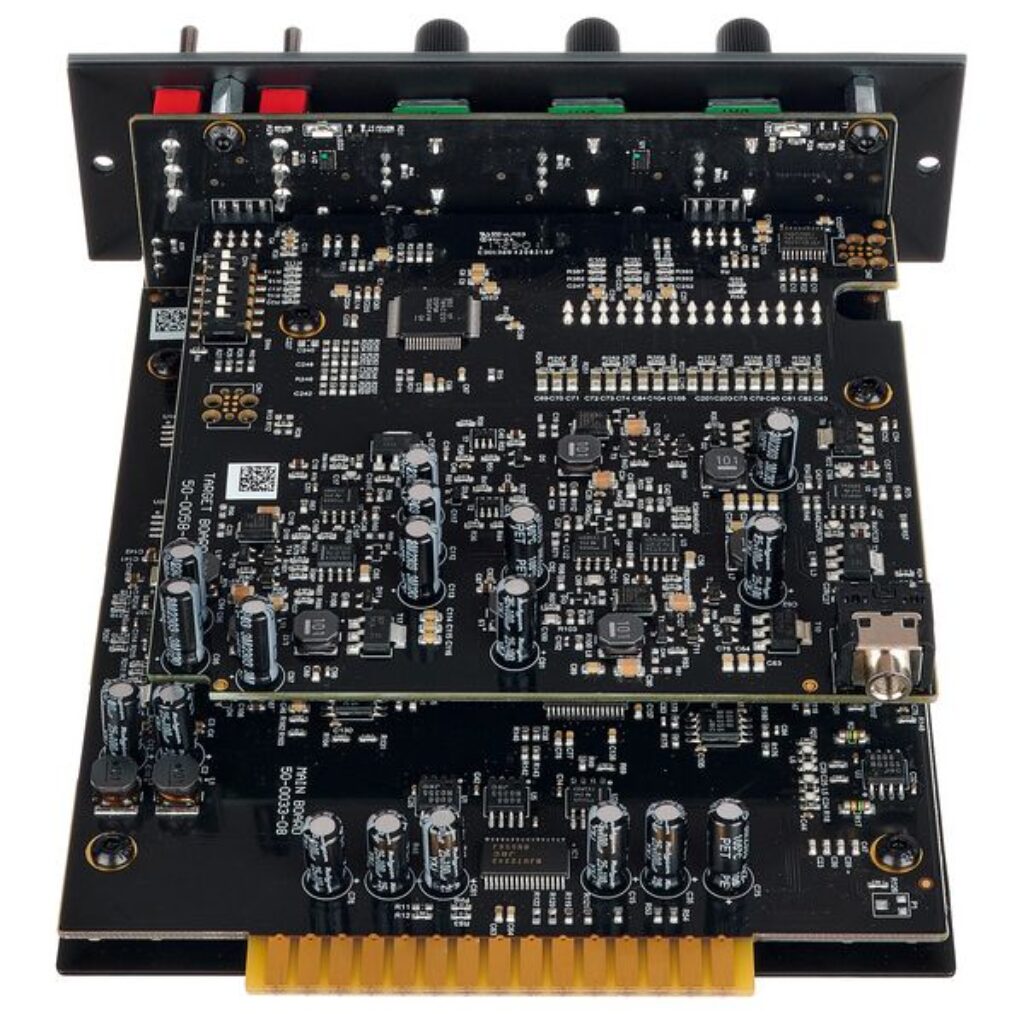
Three Band Parametric Architecture: Low, Mid, and High Bands
Where exactly is each band located in the signal path of the Cranborne Audio Carnaby 500, and what makes their respective topologies so special? The three-band parametric architecture uses dedicated harmonic saturation circuits for each band, each with +/-10 dB of gain and its own tri-color saturation LEDs.
Band Specification
- Low-Shelf 20 Hz-420 Hz, subharmonic clipping via hard-clip topology
- Mid-Peaking 200 Hz-6.2 kHz, harmonic warmth with fixed Q
- High-Shelf 5 kHz-25 kHz, gentle saturation for airiness and expansion
Please note the intentional frequency overlaps between the bands, Low and Mid share 200 Hz-420 Hz, while Mid and High overlap at 5 kHz-6.2 kHz.
This crossover design offers tremendous sonic flexibility and allows harmonic saturation to be layered across shared regions to achieve a combined sound shaping effect that is not available in conventional EQ architectures.
Level Gain-Staging: Input/Output Trimming and Drive Options
The Carnaby 500’s master input and output controls each offer ±20 dB of gain, giving sound engineers precise control over the internal signal levels. By boosting the input significantly, we send the signal at a higher level into the parametric bands, creating analog saturation and harmonic distortion that add more weight and character.
Conversely, when the input is reduced, more headroom is available for transparent, surgically precise sound shaping.
The output trim then compensates for any level changes, ensuring unity gain or targeted level boosts further down the signal chain. A master LED for level/clipping indication monitors the signal status in real time, allowing us to overdrive the signal intentionally rather than blindly. This flexibility in gain staging transforms the Carnaby from a subtle tone enhancer into an aggressive tone-shaping tool.
Best suited for: Recording and mixing engineers looking for a unique analog tone-shaping tool that ranges from subtle harmonic enhancement to aggressively saturated character, all in a compact 500-series format.
Advantages:
- ±20 dB input/output gain controls offer tremendous flexibility in gain staging, allowing you to adjust everything from transparent enhancement to heavy analog distortion
- OptoSync wireless optical coupling enables seamless stereo pairing without cables
- Detented potentiometers ensure precise, reproducible recall across different sessions
Disadvantages:
- Relatively high power consumption (140-160 mA) may limit how many units can share a single 500-series rack
- The unique approach using harmonic saturation has no direct precedent, which can make the learning curve steeper for engineers accustomed to traditional EQ workflows
- The single-slot design with a fixed Q-factor in the midrange band limits surgical precision compared to fully parametric equalizers
- Analogue EQ circuit that uses harmonic saturation to boost and cut frequencies
- Parametric LO and HI shelving bands with ±10 dB cut/boost
- Parametric MID band with ±10 dB cut/boost and fixed Q factor
- LO, MID and HI LED indicators to show saturation level
- ±20 dB input and output levels for dense harmonic saturation or clean EQ effects
OptoSync Technology and Stereo Operations
How does the Cranborne Audio Carnaby 500 achieve seamless stereo linking without a single patch cable? Through OptoSync, a proprietary stereo-linking system that uses wireless communication via optical coupling between adjacent modules.
Simply place two Carnaby 500 units side by side, and OptoSync immediately synchronizes all parameter changes across both channels, ideal for master stereo bus and subgroup operation.
- Function Adjacent units Non-adjacent units
- Connection method OptoSync wireless optical 3.5-mm TRS link jack
- Cabling required None A single TRS cable
- Calibration DIP switch auto-calibration DIP switch auto-calibration
- Latency Instant
- Recall Accuracy Grid-based steps, 100% Grid-based steps, 100%
- Integrated DIP switches handle auto-calibration and ensure that both units operate identically, regardless of component tolerances.
Is the Cranborne Audio Carnaby 500 Worth It? (Final Verdict)
Beyond its innovative stereo-linking capabilities, the Carnaby 500’s true value lies in what it delivers across the entire signal chain, a patented harmonic saturation engine that is simply unmatched in the 500-series format.
This is not a conventional 500-series EQ. It’s a non-traditional EQ that produces tailored analog timbre through three interactive bands with frequency-assigned saturation. Recording engineers get vibrant sound shaping right at the source.
Mix engineers unlock gentle high-end airiness and subharmonic expansion without phase-heavy filter networks. Mastering producers benefit from detented, stepped controls for precise recall and seamless stereo bus control via OptoSync.
Our final verdict: If you’re looking for a truly unique tool for harmonic saturation that redefines frequency shaping within a single-slot footprint, the Carnaby 500 deserves a spot in your rack.
Frequently Asked Questions
Q: What is the power consumption of the Carnborne Audio Carnaby 500 module?
A: We’re talking about approximately 140 mA at idle, rising to a peak of 160 mA, a modest draw that won’t strain your 500-series rack while still leaving plenty of headroom for the harmonic magic this innovative module delivers.
Q: Does the Carnaby 500 use detented or smooth-action potentiometers for precise repeatability?
A: All potentiometers on the front panel feature precise, detented positions, ensuring 100% accurate reproduction of every session across all parameters. We’ve designed each control so you can return to exact settings without any guesswork, repeatable results, every session.
Q: Can the Carnaby 500 be stereo-linked with modules in non-adjacent slots?
A: Yes, you can stereo-link non-adjacent slots using the 3.5-mm TRS link jack on the back panel. This bypasses OptoSync’s wireless optical coupling, allowing you to achieve precise stereo synchronization regardless of how the modules are arranged in your 500-series rack.
Q: What power supplies does the Cranborne Audio Carnaby 500 require?
A: Like any well-designed 500 Series module, we’ve engineered it to operate with standard +/-16 V DC power supplies, drawing approximately 140 mA at idle and reaching peak values of 160 mA, ensuring seamless compatibility with your existing chassis.
Q: How many 500-series slots does the Cranborne Audio Carnaby 500 occupy?
A: It occupies a single 500 Series slot and combines three interactive harmonic saturation bands, continuously variable input/output gain trims, saturation LEDs per band, and OptoSync for wireless stereo linking into a compact module you’ll want to explore.
Conclusion
We’ve traced the signal through its saturation-assigned frequency bands, examined its gain-staging architecture, and explored its OptoSync stereo linking capabilities. The Carnaby 500 isn’t just another EQ, it’s a new topology.
If you’re looking for harmonic richness that static filters can’t deliver, if you’re building a 500-series chain that demands character, and if you appreciate patented analog innovation, then this module deserves a spot in your rack.
Related Articles
- Drawmer MQ-2 Review: Great Stereo EQ & Compressor Module!
- Heritage Audio 500 Series: Big Brands-More Choices!
- 500 Series and DAW: Complete Hybrid Studio Guide
- Neve RMX16 Review: Unique 500 Series Digital Reverb!
- API Audio 500-8 Lunchbox Review: Home Sweet Home!
- Trident Audio SC2-500 Review: Big Optical Compressor!
- Drawmer OC-1 Review: Great 500 Series Opto Compressor!
- Elysia xpressor neo Review: Amazing Class A Compressor!
- Trident A-Range 500 Series EQ Module Review!