AEA RPQ503 Review
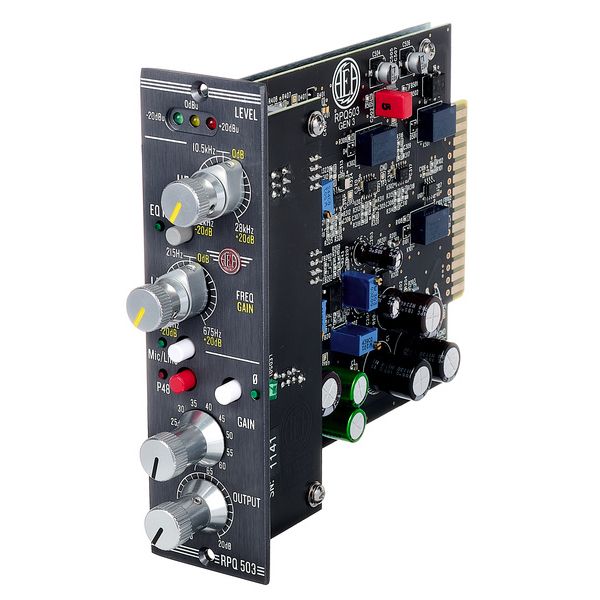
- With 2-band EQ with API 500 format
- AEA Gen 3 preamp circuitry
- Ultra-high input impedance: 68 kOhm (phantom power deactivated)
The AEA RPQ503 delivers 85dB of ultra-quiet gain through Fred Forssell’s 3rd-generation circuit, hitting an EIN of -130dBu and THD+N of just 0.0018%. Its 68k Ohm input impedance preserves full bandwidth and transient detail from passive ribbon mics.
The dual-band CurveShaper EQ offers ±20dB of sweepable shelving, while Mic/Line switching converts the module into a standalone program EQ. We’ll break down how each stage performs across real-world tracking and mixing scenarios below.

What Is the AEA RPQ503 500 Series Preamp?
AEA’s RPQ503 packs Fred Forssell’s 3rd-generation RPQ circuit into a single-width 500 series module, delivering up to 85dB of ultra-quiet gain in a compact, Made-in-USA design.
This 500 series preamp splits its gain architecture across a 12-position switched control (+7dB to +65dB) and a continuous output trim adding up to +20dB.
The AEA RPQ503 achieves ultra-low noise performance with an EIN of -130dBu and THD+N of just 0.0018%, ensuring pristine signal integrity from source to output.
The 3rd generation circuit design reflects years of refinement specifically targeting ribbon microphone amplification. Its made-in-USA heritage reinforces build quality and component selection.
You’re getting 85 dB of clean gain without compromise, engineered for engineers who demand transparent, specification-driven performance from every rack unit.
Why Input Impedance Matters: The 68k-Ohm Ribbon Advantage
At 68k Ohms, the RPQ503 presents virtually no resistive load to the transducer.
The passive ribbon microphone’s motor assembly vibrates freely, preserving full bandwidth extension and micro-dynamic detail that lower-impedance preamps suppress.
You’ll hear wider high-frequency reach, more accurate transient reproduction, and greater dynamic fidelity across the entire signal path.
For engineers pushing passive ribbons on detailed sources, this impedance architecture delivers measurably more complete captures.
The Expanded CurveShaper EQ: Sweeping Lows and Highs
The CurveShaper EQ section builds two sweepable shelving bands into dual-concentric potentiometers, giving you simultaneous frequency and gain control per band without eating extra panel space.
This expanded EQ section delivers ±20dB of boost or cut across both bands, keeping corrections surgical yet musical.
The LF band sweeps 40Hz to 675Hz, letting you roll off proximity boom on close-miked vocals and acoustic instruments without touching the fundamental body of the source.
The HF band covers 2kHz to 28kHz, apply a gentle HF boost to reveal silky air on dark passive ribbons without introducing harsh phase artifacts.
The EQ’s shelving topology maintains natural rolloff slopes, preserving transient integrity. An EQ In/Out switch with status LED lets you A/B corrections instantly against the flat signal path.

Mic vs. Line Mode: Dual Utility in Tracking and Mixing
Beyond its role as a ribbon-optimized mic preamp, the RPQ503’s front-panel Mic/Line switch reroutes the signal flow to bypass the mic pre stage entirely, converting the module into a standalone program EQ.
In line mode, you’re feeding DAW returns or mix bus stems directly into the EQ section for high-end tonal sculpting during mixdown. The dedicated EQ bypass switch lets you A/B processed versus dry signals instantly.
This dual-utility architecture supports:
- Tracking: full mic preamp gain path with EQ shaping for ribbons and dynamics
- Mixing: line mode processing on vocal stems or bus groups
- A/B comparison: EQ bypass for transparent before/after evaluation
- Signal integrity: bypassed preamp stage eliminates unnecessary gain stages
Real-World Studio Performance: Drums, Vocals, and Acoustic Instruments
Having covered the RPQ503’s dual signal-path architecture, let’s put it to work on actual sources.
Pairing a low-output ribbon microphone like the AEA R84 with the RPQ503’s 85 dB of clean gain transforms quiet fingerpicked acoustic guitar into a fully resolved, noise-free signal. We’re talking about an EIN of -130dBu, soft orchestral passages emerge from silence without hiss or artifacts.
On drum overheads, the RPQ503’s transient response proves exceptional. The 68k Ohm input impedance preserves every stick attack and cymbal decay captured by passive ribbons.
Among high-gain preamplifiers, this unit distinguishes itself through speed and transparency. Grand piano tracking benefits identically, hammer transients remain intact while the HF shelf adds controlled air above 2kHz.
- Continuously adjustable low and high shelving EQ, ±20 dB
- EQ can be switched on separately with centre detent for precise neutral position
- +48 V phantom power for condenser microphones
- Polarity switch for phase correction
- Switchable between microphone and line input
Is the AEA RPQ503 Worth It? (Final Verdict)
So where does the AEA RPQ503 land in the crowded 500 series preamp market? This mic preamp delivers 85dB of high-gain headroom with -130dBu EIN, purpose-built for ribbon microphones and quiet sources.
Here’s who should buy it:
- Recording engineers tracking low-output passive ribbons needing transparent gain without noise
- Ribbon microphone enthusiasts who demand 68k Ohm input impedance to prevent loading
- Mix engineers seeking flexible tone shaping via the Line input for stem processing
- Home studio owners wanting boutique-grade preamplification in a single-width footprint
The CurveShaper EQ transforms dark ribbon signals with surgical precision across two sweepable bands.
We’re confident the AEA RPQ503 earns its price, it’s a specialized tool that solves real signal-chain problems no generic preamp addresses.
Frequently Asked Questions
Q: Can the AEA RPQ503 Power Condenser Microphones Requiring 48V Phantom Power?
A: Yes, we’ve you taken care of, the RPQ503 doesn’t just whisper sweet gain to ribbons.
Its front-panel Phantom Power switch delivers +48V DC to the mic input, fully powering condenser microphones that require it.
Note that engaging phantom shifts the input impedance from 68k Ohms down to 11.3k Ohms, altering the load seen by your mic’s output stage.
We recommend factoring this impedance change into your signal-flow planning for best performance.
Q: What 500 Series Lunchbox Chassis Are Compatible With the RPQ503?
A: The RPQ503 fits any standard 500-series chassis supplying +/-16V DC rails, we’re talking API, Radial, BAE, Cranborne, and similar lunchboxes.
Its single-width form factor and minimal power draw mean you won’t stress even budget racks.
We’d recommend verifying your chassis delivers clean, regulated voltage for ideal noise performance.
This flexibility lets you integrate the RPQ503’s 85dB gain architecture and EQ into virtually any modular signal chain.
Q: How Does the RPQ503 Compare to Aea’s Standalone TRP3 Preamp?
A: The RPQ503 packs the same 3rd-generation RPQ circuit architecture and 85dB gain ceiling as AEA’s standalone TRP3, but compresses it into a single-width 500-series module.
You’ll get identical 68k Ohm input impedance and ultra-low -130dBu EIN, plus the full dual-band EQ.
The key difference? The RPQ503 integrates directly into your lunchbox signal chain, eliminating standalone rack space while delivering TRP3-caliber ribbon amplification.
Q: What Is the Total Current Draw on Standard 500 Series Rails?
A: AEA doesn’t publish exact current draw figures for the RPQ503, but we can tell you it’s whisper-quiet on standard +/-16V DC 500-series rails, practically invisible to your lunchbox’s power budget.
The unit’s single-width form factor and efficient 3rd-generation RPQ circuit architecture guarantee minimal current consumption, leaving headroom for power-hungry neighboring modules.
You’ll want to confirm precise mA specs directly with AEA for your rack’s total power allocation.
Q: Does the RPQ503 Work Well With High-Output Active Ribbon Microphones?
A: Yes, it works exceptionally well. Active ribbons typically output hotter signals, so you won’t need the RPQ503’s full 85dB gain range, just dial back the 12-position switched gain and fine-tune with the continuous output trim.
Engaging phantom power shifts input impedance to 11.3k Ohms, properly powering active electronics. You’ll still utilize the EQ‘s sweepable HF band (2kHz–28kHz) to sculpt top-end detail beyond what active ribbons already deliver.
Conclusion
We’d apologize for how much we love the RPQ503, but 85dB of gain with that noise floor makes remorse impossible. Apparently, AEA thought ribbon users enjoyed hiss and anemic low-end, then built the exact opposite.
The 68k-ohm input impedance preserves transient detail, the EQ surgically rescues dark signals, and mic/line switching doubles your workflow. At this price-to-performance ratio, our only complaint is needing more lunchbox slots.
Related Articles
- Rupert Neve 542 Review: Legacy Tape Emulator!
- Elysia xfilter 500 Review: Pro Audio Stereo Equalizer!
- Chandler tg2 500 Review: 500 Series Microphone Preamp!
- SSL G Bus Review: Great 500 Series Compressor Module!
- Radial Workhorse Cube Review: Amazing 500 Series Chassis!
- Pultec EQP-500X Review: Huge 500 Series Program Equalizer!
- SSL Six 500 Series Review: Big Channel Strip in 500!
- Rupert Neve Designs 511 Review: Amazing Mic-Pre!