Drawmer MQ-2 Review
- Inspired by the Motown EQ of the 1960s
- ‘CRUSH’ function for harmonic saturation
- Stepless boost or cut by ±10 dB
- Hardwired bypass
Here we have another unit from a well known brand. This was released not that long ago, so we decided it is a good time to write about it and share our knowledge with you.
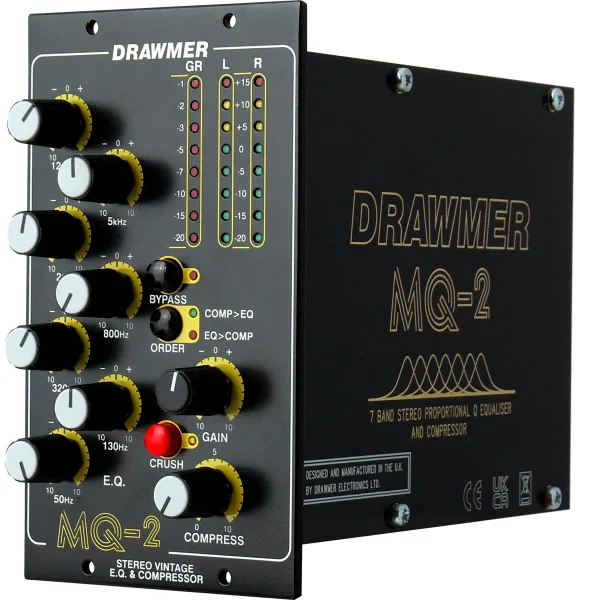
The Drawmer MQ-2 is a dual-slot 500 series stereo module combining a 7-band proportional-Q EQ (50 Hz-12.5 kHz, ±10 dB), a program-dependent one-knob compressor, and the CRUSH harmonic saturation circuit.
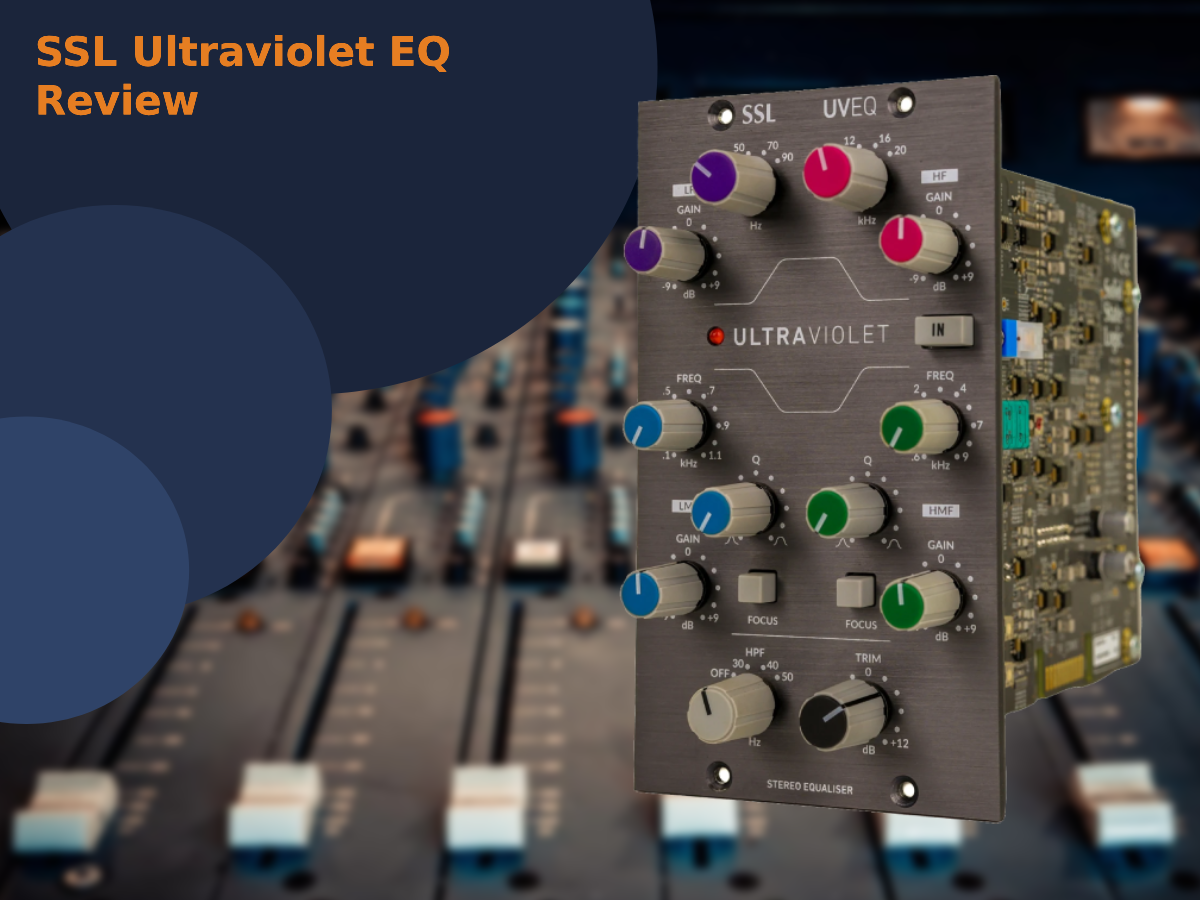
We’ve found its dynamic Q behavior delivers musical results fast, while the ORDER toggle lets you route EQ pre- or post-compression for precise signal shaping. It’s a serious contender against modules like SSL’s UltraViolet EQ, and we’ll break down exactly why below.

Introduction & Overview of the Drawmer MQ-2
The Drawmer MQ-2 packs a 7-band equalizer, a program-dependent one-knob compressor, and Drawmer’s CRUSH harmonic saturation circuit into a single dual-slot 500 series stereo module.
Inspired by the legendary Motown EQ units from Hitsville U.S.A., this UK-manufactured processor delivers analogue warmth through seven fixed musical frequency bands spanning 50 Hz to 12.5 kHz.
What makes the Drawmer MQ-2 particularly efficient is its single-knob linked stereo operation, one control drives both channels simultaneously, streamlining stereo bus and stem processing.
The adjustable stereo compressor automatically shapes attack and release envelopes based on program material, while the harmonic saturation stage generates second and third order distortion that scales dynamically with your EQ and compression settings.
It’s a complete signal-shaping toolkit designed for tracking and mixdown alike.
The Motown-Inspired 7-Band Proportional-Q EQ Circuit
At the heart of the MQ-2’s tonal architecture sits a 7-band equalizer built around seven fixed frequency centers: 50 Hz, 130 Hz, 320 Hz, 800 Hz, 2 kHz, 5 kHz, and 12.5 kHz. Each band delivers up to ±10 dB of continuous boost or cut across musical frequencies selected for immediate tonal impact.
The EQ circuit adjusts dynamically: subtle 1-3 dB adjustments produce wide, gentle bell curves that deliver classic analogue warmth, while aggressive moves toward ±10 dB naturally narrow the Q for surgical precision.
This behavior eliminates bandwidth guesswork entirely. The Drawmer MQ-2 lets you shape tone instinctively, dial in what sounds right, and the proportional-Q response handles the rest.
It’s a tracking-optimized design that prioritizes speed and musicality over parameter overload.

Integrated One-Knob Compression & Signal Routing (Order Switch)
Sitting alongside the 7-band EQ, the MQ-2’s program-dependent compressor distills dynamic control down to a single knob, one continuous control that simultaneously sets threshold and ratio while the circuit automatically adjusts its attack and release envelopes to match the incoming signal’s transient behavior.
This program-dependent envelope design means fast transients trigger quicker attack times, while sustained material receives slower, more transparent gain reduction. The one-knob compressor keeps workflow immediate without sacrificing dynamic intelligence.
The ORDER toggle button lets you swap between EQ-pre-Compressor and Compressor-pre-EQ routing. Placing compression post-EQ means boosted frequencies hit the detector harder, creating frequency-dependent dynamic shaping.
Reversing the order delivers more consistent compression before tonal sculpting. The 8-LED gain reduction meter displays up to 20 dB GR, giving you precise visual feedback during processing.
Adding Analogue Heat: The CRUSH Harmonic Saturation Circuit
Beyond compression and EQ, the MQ-2’s CRUSH button activates a harmonic saturation circuit derived directly from the Drawmer 1971, injecting second and third order dynamic harmonic distortion into the signal path.
You’ll hear added weight in the low end, density through the midrange, and smooth shimmer across high frequencies, all without reaching for additional outboard gear.
What makes this crush circuit particularly responsive is its dynamic interaction with the MQ-2’s other processing stages.
Increasing EQ boost drives more signal into the harmonic saturation engine, scaling the depth of harmonic distortion proportionally.
Similarly, pushing the compression harder feeds a hotter signal into CRUSH, intensifying the analogue coloration.
This interconnected behavior means you’re not just stacking effects, you’re shaping a single, cohesive tonal response that reacts intelligently to your processing decisions.
- The EQ and compressor order can be swapped in the signal path to suit your preference.
- EQ Frequencies: 50 Hz, 130 Hz, 320 Hz, 800 Hz, 2,000 Hz, 5,000 Hz, 12,500 kHz, +/- 10 dB Gain
- Input impedance: 20 kOhm
- Frequency range: 20 – 20.000 Hz +/-0.5 dB
- Dimensions: 2 x 500 series slot
Real-World Applications: Tracking, Mixing & Stereo Bus Processing
The MQ-2’s dual-slot stereo-linked topology makes it a natural fit across at least five common studio scenarios. Drum overheads, stereo mix buses, acoustic guitars, synth pads, and vocal sub-mixes, each benefiting from the module’s EQ, program-dependent compression, and optional CRUSH saturation in distinct ways.
During tracking and mixing, the Drawmer MQ-2’s EQ lets you sculpt drum overheads with surgical 5 kHz air while the compressor tames transients automatically, watch the gain reduction meter for 3-6 dB of transparent leveling.
On stereo mix buses, running clean preserves detail; engaging CRUSH introduces that classic warm analogue sound with dynamic harmonic content.
For synth pads and acoustic guitars, subtle 130 Hz and 320 Hz adjustments widen or tighten body without phase artifacts, maintaining precise stereo field balance throughout.
Final Verdict: Value, Pros & Cons, and Competitor Comparison
Drawmer’s MQ-2 earns its rack space because it solves a specific problem: fast, musical stereo shaping without menu-diving or recall headaches. Its seven Motown-inspired bands, single-knob stereo control, versatile CRUSH circuit, and built-in metering deliver an effortless workflow.
However, fixed frequencies limit surgical precision, no parametric sweep here, and the compressor pumps noticeably when overdriven.
Against competitors like SSL’s UltraViolet EQ or Cranborne’s Carnaby 500, the MQ-2 distinguishes itself through integrated compression and character-driven EQ in one stereo module.
We’d recommend it to engineers prioritizing vibe-forward stereo bus processing over clinical parametric control.
Frequently Asked Questions
Q: Is the Drawmer MQ-2 Compatible With All Standard 500 Series Chassis?
A: Yes, the MQ-2 fits any standard 500 series chassis, but it’s a dual-slot stereo module, so you’ll need two adjacent slots. We recommend verifying your chassis supports linked stereo operation for peak performance.
Q: What Is the Expected Lifespan of the Relay Bypass Switch?
A: Rock-solid by design, we can’t quote an exact cycle count since Drawmer doesn’t publish relay lifespan specs, but quality hardwired relay bypasses typically endure 10 million+ switching cycles, far outlasting your studio’s lifetime.
Q: Does Drawmer Offer a Warranty for the MQ-2 Module?
A: We don’t have specific warranty details for the MQ-2 in our specs. We’d recommend contacting Drawmer directly or your authorized dealer, they’ll confirm coverage terms for this Yorkshire-built, through-hole component module.
Q: Can the MQ-2 Be Used for Mid-Side Processing?
A: The MQ-2 doesn’t include built-in mid-side encoding/decoding. It’s designed as a linked stereo processor. You’d need an external M/S matrix before and after the module to achieve mid-side processing.
Q: What Power Consumption Does the MQ-2 Draw From the 500 Series Rack?
A: The MQ-2 draws around 200mA, since it is a two-slot module. It draws all the power from the left rail, feeding the whole unit without the need to draw power from both rails.
Conclusion
The Drawmer MQ-2 is the real deal, a stereo 500 series module that punches well above its weight. Its proportional-Q EQ delivers musical curves without phase issues, the program-dependent compressor responds transparently across dynamic material, and the CRUSH circuit adds harmonically rich saturation when you need it.
We’d stack it confidently against modules costing twice as much. For stereo bus processing with genuine analogue signal path integrity, it’s a no-brainer.
Related Articles
- Rupert Neve 542 Review: Legacy Tape Emulator!
- Elysia xfilter 500 Review: Pro Audio Stereo Equalizer!
- Chandler tg2 500 Review: 500 Series Microphone Preamp!
- SSL G Bus Review: Great 500 Series Compressor Module!
- Radial Workhorse Cube Review: Amazing 500 Series Chassis!
- Pultec EQP-500X Review: Huge 500 Series Program Equalizer!
- SSL Six 500 Series Review: Big Channel Strip in 500!
- Rupert Neve Designs 511 Review: Amazing Mic-Pre!