SSL Ultraviolet EQ Review
- Packs 4 bands of SSL console-style sound shaping into a 500 Series module
- Fusion-derived high/low shelving bands and 2 fully parametric midbands with ±9dB of gain
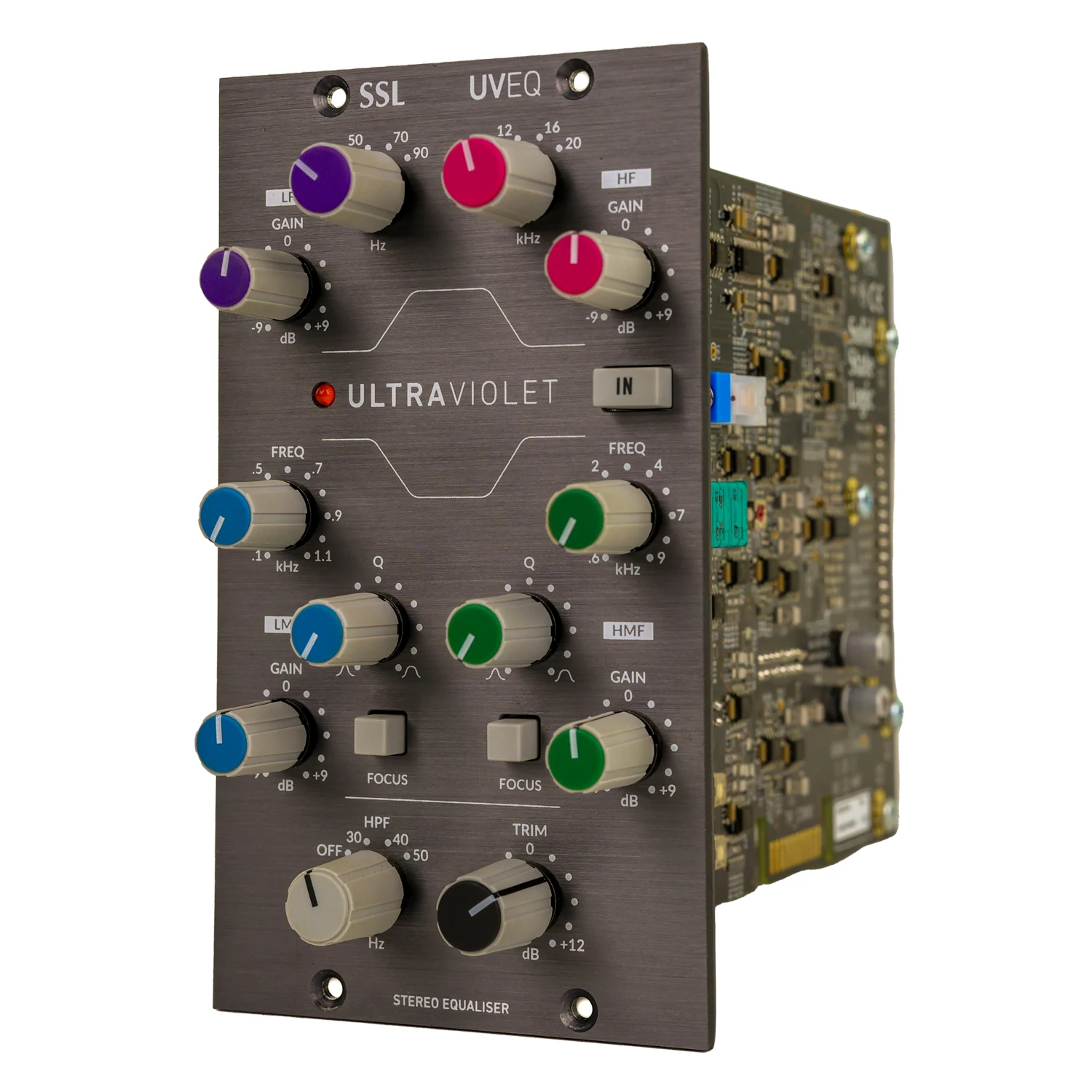
SSL’s UltraViolet is a dual-slot 500-series stereo EQ built around minimum-phase circuitry that preserves transient integrity and stereo coherence.
We’ve found its Fusion-derived HF/LF shelves musical yet precise, while the two parametric midbands, especially in Focus mode, deliver surgical notch capability up to ±18 dB. An 18 dB/octave HPF pairs with the low shelf for Pultec-style low-end shaping. Now, we’ll break down each section so you can decide if it belongs on your bus.

What Is the SSL UltraViolet 500 Series Stereo EQ?
At its core, the minimum phase-shift design preserves transient integrity and stereo imaging, making it exceptionally suited for mix bus, stem, and mastering equalizer applications.
We’re looking at shelving HF/LF bands, two fully parametric mids with Focus switching, a dedicated high-pass filter, and output trim, all packed into a standard dual-slot 500-series footprint.
It’s engineered for engineers who demand surgical control without sacrificing musicality.
Fusion Heritage: Minimum Phase-Shift Shelving Bands
How does the UltraViolet EQ deliver broad tonal shaping without compromising stereo coherence? The answer lies in its minimum-phase shelving bands inherited directly from SSL’s Fusion processor.
This topology preserves phase coherence and stereo imaging by minimizing phase rotation across the frequency spectrum, ensuring transients remain tight and unsmeared.
The shelving bands offer selectable frequencies with +/-9dB gain:
- LF shelf: 30/50/70/90Hz selections add controlled low-end weight without muddying the mix foundation.
- HF shelf: 8/12/16/20kHz selections introduce high-end sheen that remains transparent and spatially precise.
- Minimum-phase architecture: both bands maintain natural phase alignment, preventing the stereo-field degradation common in linear-phase or higher-order designs.
This combination delivers musically effective tonal sculpting that’s analytically clean across full stereo bus applications.
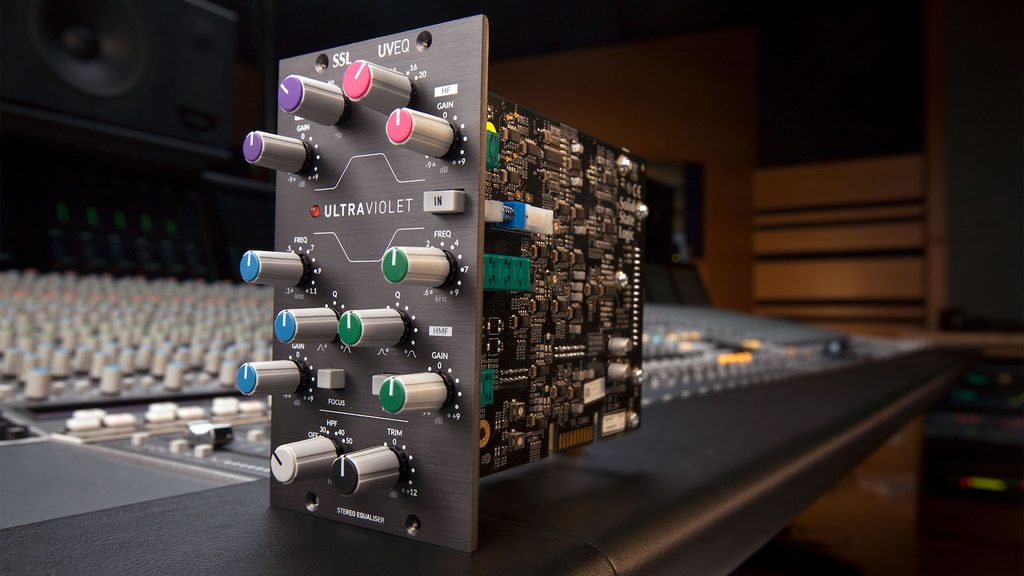
Fully Parametric Midbands and Precision “Focus” Mode
Where the shelving bands handle broad tonal strokes, the UltraViolet EQ‘s two fully parametric midrange bands deliver the surgical precision that sets this module apart from its Fusion ancestor. The LMF (100Hz-1.1kHz) and HMF (400Hz-6kHz) midbands offer continuously variable frequency and Q controls, giving this stereo equalizer true parametric EQ flexibility within a 500 series format.
The real innovation lies in the focus switch. Engaging focus on either mid-band narrows the curve into a tight notch filter while doubling gain range from ±9dB to ±18dB. This transforms the UV EQ from a musical shaping tool into a resonance-hunting instrument. We’re talking pinpoint removal capabilities that eliminate the need for a separate dedicated notch processor alongside your bus processing chain.
Low-End Sculpting: HPF and the Classic Boost/Cut Technique
Beyond the parametric midbands, the UltraViolet EQ’s dedicated 18dB/octave High-Pass Filter provides three switchable corner frequencies, 30Hz, 40Hz, and 50Hz, designed to strip sub-bass energy before it muddies your stereo bus.
Pairing the high-pass filter with low shelving boost creates a classic Pultec-style low-end curve that simultaneously cuts sub-bass rumble and reinforces musical low-end:
- Set the HPF to 40Hz or 50Hz to attenuate inaudible subsonic content beneath your target frequency.
- Engage the low shelving band at 50Hz or 70Hz with a moderate boost to restore punch and weight above the HPF rolloff point.
- Fine-tune the interaction until kick drum impact and bass guitar definition emerge without bloat.
This boost/cut technique tightens low-end transients while preserving perceived fullness across your mix bus.
- LF Shelf EQ: +/- 9dB gain @ 30/50/70/90Hz
- HF Shelf EQ: +/- 9dB Gain @ 8/12/16/20kHz
- HMF Parametric EQ: +/- 9dB Gain @ 600Hz – 6kHz
- LMF Parametric EQ: +/- 9dB Gain @ 100Hz – 1.1kHz
- Gain Trim: +/- 12dB
Master Bus Workflow: Output Trim, Ergonomics, and G-Comp Integration
Why does front-panel ergonomics matter on a stereo bus EQ? The SSL UltraViolet uses single-knob ganged stereo controls across every parameter, eliminating channel-to-channel mismatches that compromise imaging.
The hardware stereo bypass provides instant A/B comparison without signal-path latency. For master bus workflow, the output trim control (+/-12dB) proves essential, you’re compensating for cumulative EQ gain changes before hitting A/D conversion thresholds or downstream dynamics. Precise gain staging prevents clipping converters or underdriving subsequent processors.
Pairing the UltraViolet alongside the G-Comp in a 500-series rack creates a dedicated stereo bus chain with SSL-grade signal integrity. You’ll shape tonal balance pre-compression or post-compression, with front-panel ergonomics ensuring rapid, confident adjustments during critical mix decisions.
Is the SSL UltraViolet EQ Worth It? (Final Verdict)
So does the SSL UltraViolet EQ justify its price point in a crowded 500-series market? Absolutely. This stereo EQ module delivers pristine equalization with surgical capability that few competitors match.
We’d recommend the SSL Ultraviolet to:
- Mastering engineers who need transparent shelving and precise mid bands for final-stage corrections without phase degradation.
- Mix engineers seeking a dedicated mix bus EQ module with focus mode for notch-level resonance control at +/-18dB.
- Studio owners building premium 500 series signal chains around SSL’s G-Comp ecosystem.
The Ultraviolet isn’t just another EQ, it’s a purpose-built stereo bus tool. If you’re after SSL-grade analog processing with expanded parametric flexibility, this module earns its rack space decisively.
Frequently Asked Questions
Q: Can the SSL Ultraviolet EQ Be Used in Mono Applications?
A: While the UltraViolet EQ is designed as a ganged stereo processor occupying dual 500-series slots, we can’t independently adjust left/right channels, making it suboptimal for true mono applications requiring single-channel processing.
Q: Does the Ultraviolet EQ Require Specific 500-Series Chassis to Operate?
A: No, it doesn’t demand any specific chassis; virtually every standard 500-series rack on the planet will work. You’ll just need two adjacent slots since it’s a double-slot stereo module requiring standard dual-slot compliance.
Q: What Is the Street Price of the SSL Ultraviolet EQ?
A: From what we know, the price is somewhere around 500$. We’d recommend checking authorized SSL dealers or SSL’s official site for current pricing, as 500-series module costs can vary by region and retailer.
Q: How Does the Ultraviolet EQ Compare to SSL’s Plugin Emulations?
A: We can’t directly compare the UltraViolet EQ’s analog minimum phase-shift circuitry to SSL’s plugin emulations, as SSL hasn’t released a dedicated UltraViolet plugin. The hardware’s analog topology delivers transient clarity that digital approximations intrinsically struggle to replicate.
Q: Is There a Recall Sheet Available for Saving Ultraviolet EQ Settings?
A: SSL doesn’t include a dedicated recall sheet, but coincidentally, we’ve found that documenting each stepped frequency selection, Q position, and Focus engagement state precisely lets us recreate settings with repeatable accuracy across sessions.
Conclusion
We won’t sugarcoat it; the UltraViolet isn’t exactly gentle on your wallet. But what you’re acquiring is SSL’s refined minimum phase-shift topology with surgical parametric control that doesn’t leave fingerprints on your transients.
The Focus mode alone justifies the investment for those requiring precise midrange intervention. If your master bus chain feels underserved, this double-slot module fills that gap with analytical precision and unmistakably musical results.
Related Articles
- Drawmer MQ-2 Review: Great Stereo EQ & Compressor Module!
- Heritage Audio 500 Series: Big Brands-More Choices!
- 500 Series and DAW: Complete Hybrid Studio Guide
- Neve RMX16 Review: Unique 500 Series Digital Reverb!
- API Audio 500-8 Lunchbox Review: Home Sweet Home!
- Trident Audio SC2-500 Review: Big Optical Compressor!
- Drawmer OC-1 Review: Great 500 Series Opto Compressor!
- Elysia xpressor neo Review: Amazing Class A Compressor!
- Trident A-Range 500 Series EQ Module Review!