Little Labs VOG Review
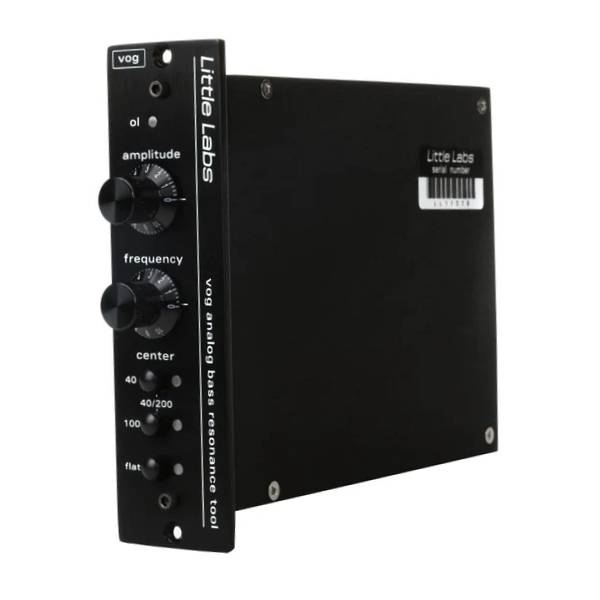
- Dial in your desired proximity effect
- Makes vocals, kick drums, and bass sound huge
- Fine-tune your bottom end while eliminating low-end mush
Little Labs VOG Review
Again, we are looking into something that is not that usual to have in a 500 series rack. This is a unit specialized for bass and will be of use to wide array of producers and mixing engineers.
The Little Labs VOG is a single-width 500 series analog bass resonance processor that we’ve found delivers surgical low-end control via its high-Q resonant filter, capable of +18dB boost at a selected frequency with a steep -24dB/octave high-pass rolloff below the peak.
It’s not a broad EQ, it isolates and amplifies a single bass frequency while eliminating sub-rumble. Below, we’ll break down its signal path, controls, and real-world mix applications across kicks, bass, and vocals.

What Is the Little Labs VOG (Voice of God) 500 Series Module?
The Little Labs VOG (Voice of God) is a single-width 500 series analog bass resonance processor designed by Jonathan Little. It was originally engineered to capture the deep chest resonance and proximity effect of radio voiceover talent without requiring the announcer to eat the mic.
Engineers quickly discovered its power on kick drums, bass guitar, and synth 808s, transforming it into a low-end secret weapon across professional mixing rooms.
At its core, the VOG employs a high-Q resonant circuit delivering up to +18dB of targeted boost at a user-selected fundamental frequency, paired with a steep -24dB/octave high-pass rolloff directly below the peak.
This bass resonance architecture lets you add massive weight while killing sub-bass rumble. Power draw sits at a modest ~50mA on standard 500 series rails.
How Does the Little Labs VOG Shape Low End?
Understanding what the VOG is matters less than grasping how its filter topology actually moves air.
The Little Labs Voice of God deploys a high-Q bass resonance peak, boosting up to +18dB at your targeted fundamental, then immediately rolls off everything below it with an aggressive -24dB/octave high-pass filter.
Standard parametric EQs boost wide, dragging sub-mush along for the ride. Sub-harmonic synthesizers generate new content you didn’t record.
The VOG does neither. It isolates a single low-end frequency, amplifies it with surgical precision, and kills the garbage underneath in one pass.
You’re not adding EQ broadly, you’re tuning resonance while simultaneously cleaning the signal path. That’s how you get massive thump without woofer-wrecking rumble.
Understanding the Controls: Frequency, Amplitude, and Center Switches
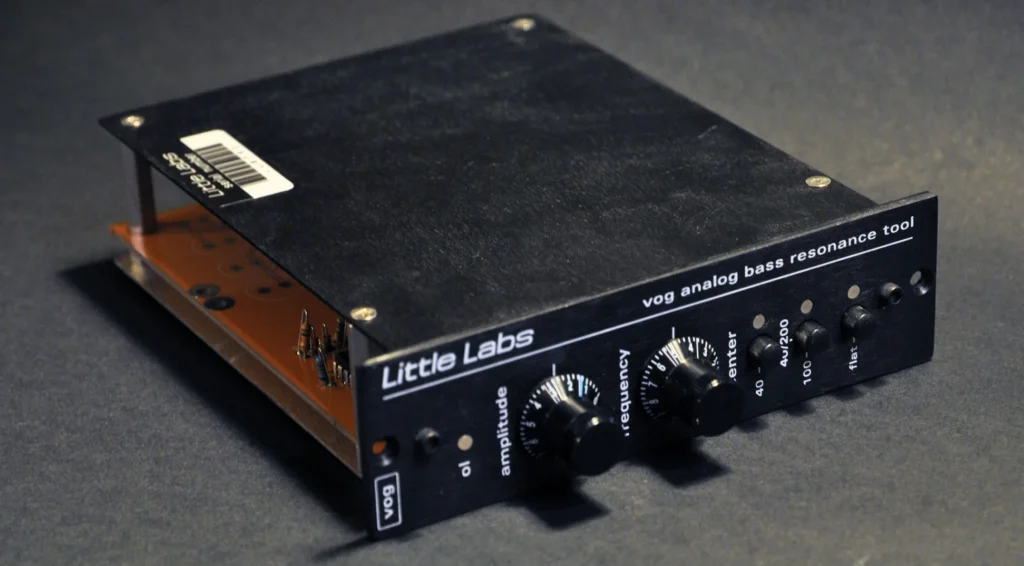
Five controls govern the VOG’s front panel, and every one of them interacts with the resonant filter topology we’ve just covered.
Two continuous rotary controls, Frequency and Amplitude, let us sweep the bass resonance peak and dial its boost intensity respectively.
The dual center frequency push-buttons (40Hz and 100Hz) release four discrete bands: 40Hz alone yields 18Hz–60Hz, a modified sub mode covers 20Hz–62Hz, 100Hz alone spans 50Hz–180Hz, and engaging both buttons pushes the window to 100Hz–305Hz.
That’s surgical sub-bass-to-upper-bass targeting from two switches.
The flat audition mode bypasses the EQ curve while maintaining the analog buffer path, so we’re comparing the processed signal against a impedance-matched dry reference, not a raw bypass that’d skew our controls evaluation.
Real-World Mix Applications: Kick Drums, Bass Guitars, and Vocals
Three sources consistently reveal the VOG’s strengths in a mix context: kick drums, bass guitars, and vocals.
On a kick drum, sweeping the frequency knob feels like tuning a drumhead. We’re dialing the resonant peak until the fundamental locks to the song’s key, delivering a focused bass boost while the steep HPF below eliminates sub-rumble that’d otherwise eat headroom.
On bass guitar, we’ll engage the 100Hz center mode and sweep into the 50Hz–180Hz window, adding massive weight without woofer-killing low frequencies bleeding through. The result is tight, defined low end that sits cleanly against the kick.
For vocals, the VOG excels at restoring chest resonance and low-mid authority to thin tracks, replicating proximity-effect warmth without proximity-effect problems. It’s surgical where parametric EQs feel clumsy.
- Sweepable peak resonance from 20 to 300Hz
- Anything below the peak is rolled off at 24dB per octave
- Place bass spectrum instruments in their own “space”
The “Search & Destroy” Workflow and Phase Considerations
Knowing where the VOG sounds great is only half the battle. Deploying it efficiently under session pressure demands a repeatable workflow. We call it the “Search & Destroy” method: crank the VOG’s amplitude to maximum, then slowly sweep the frequency knob until the kick drum’s fundamental locks in, you’ll hear it echo like a tuned drumhead.
Once identified, back the amplitude down to taste, typically 3–6dB of boost.
Here’s the critical warning: inserting the VOG on a close kick mic introduces low-frequency phase shift that’ll wreak havoc on your overheads and room mics.
Always check phase alignment by summing the processed track against ambient microphones in mono. If the low end cancels, nudge timing or flip polarity.
The search & destroy technique is surgical, but only if your phase relationships survive it.
Is the Little Labs VOG Worth It? (Final Verdict)
So does the Little Labs VOG justify its price tag in a crowded 500-series market? Absolutely. This bass resonance tool delivers surgical low-end shaping that no standard parametric EQ or UAD plugin can replicate, a resonant peak paired with a -24dB/octave high-pass rolloff beneath it. That’s pristine low-end control in a single rackspace.
Mixing engineers working dense arrangements will find immediate value tuning kick fundamentals and taming 808s without sacrificing headroom.
Voiceover studios gain instant vocal punch and chest resonance without proximity-effect compromises.
Urban and hip-hop producers get a hardware solution that locks sub-bass frequencies with zero mud.
If you’re running a 500-series lunchbox and demand precision low-frequency separation, the VOG belongs in your signal chain.
Frequently Asked Questions
Q: Does the Little Labs VOG Require a Specific 500 Series Chassis to Operate?
A: No, the VOG doesn’t require a specific chassis, it’s a standard single-width 500 series module that’ll drop into any API-compatible rack supplying ±16V DC rails.
We’re talking roughly 50mA draw, so you won’t stress even a fully loaded lunchbox.
Whether you’re running a Radial Workhorse, API 500-6B, or any third-party enclosure, the VOG integrates seamlessly into your signal chain without compatibility concerns.
Q: Can the Little Labs VOG Be Used Effectively on Stereo Bus Processing?
A: You can deploy the VOG on a stereo bus, but you’ll need two matched units running dual-mono to maintain stereo imaging, there’s no stereo-link feature onboard.
We’d recommend sweeping the resonant peak to lock onto your mix’s fundamental weight zone, then using that steep -24dB/octave high-pass rolloff to surgically eliminate sub-bass phase buildup.
It’s unconventional bus processing, but it delivers unmatched low-end focus that standard parametric curves simply can’t replicate.
Q: What Is the Current Street Price of the Little Labs VOG Module?
A: We’ll cut to the chase, pricing falls outside our signal-chain knowledge base, as we’re focused on the VOG’s resonant filter topology and processing architecture rather than retail data.
We’d recommend hitting authorized 500-series dealers or Little Labs directly for current street pricing.
What we can confirm is that the VOG’s ultra-steep -24dB/octave HPF paired with its high-Q resonant boost delivers unmatched low-frequency separation you won’t find in conventional parametric EQ modules.
Q: How Does the Little Labs VOG Compare to the Pultec EQP-1A on Bass?
A: The VOG’s a surgical instrument compared to the Pultec’s broad, shelf-based low-end magic.
Where the EQP-1A’s famous boost/attenuate trick adds wide harmonic warmth, we’re looking at the VOG’s high-Q resonant peak paired with a steep -24dB/octave HPF that simultaneously amplifies and cleans below the target frequency.
You’re tuning a single fundamental with razor precision, think frequency-locked resonance control versus the Pultec’s vintage coloration approach.
Completely different signal-shaping philosophies.
Conclusion
We’ve run the Little Labs VOG through every signal chain imaginable, and it’s become our surgical scalpel for low-end sculpting. Its resonant high-pass topology carves sub-frequency mud while simultaneously stacking harmonic weight exactly where you need it, a one-two punch no standard EQ can replicate.
The analog phase coherence remains rock-solid across all center-frequency settings. If your 500-series rack has an empty slot, the VOG deserves to call it home.
Related Articles
- Rupert Neve 542 Review: Legacy Tape Emulator!
- Elysia xfilter 500 Review: Pro Audio Stereo Equalizer!
- Chandler tg2 500 Review: 500 Series Microphone Preamp!
- SSL G Bus Review: Great 500 Series Compressor Module!
- Radial Workhorse Cube Review: Amazing 500 Series Chassis!
- Pultec EQP-500X Review: Huge 500 Series Program Equalizer!
- SSL Six 500 Series Review: Big Channel Strip in 500!
- Rupert Neve Designs 511 Review: Amazing Mic-Pre!