API 312 Review
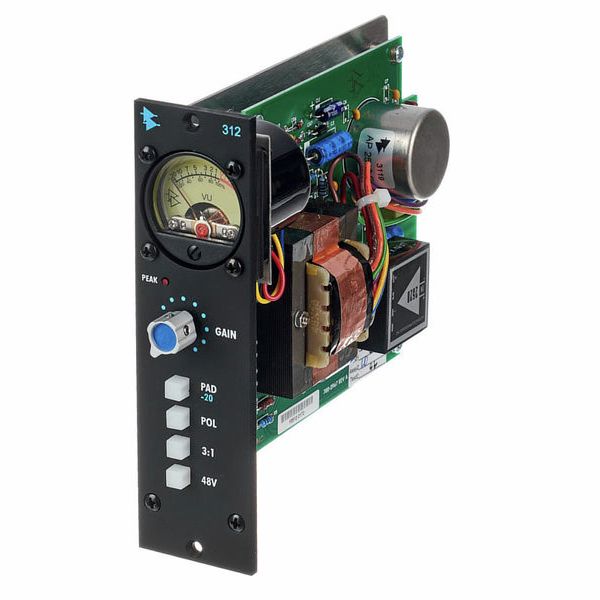
- Totally discrete circuit design with 2520 op-amp
- Proprietary AP2516 input transformer
- 20 dB Pad switch
Another amazing unit from the pioneers. We are checking this one and will provide you with hands on experience and insights. The API 312 delivers the aggressive, punchy character of classic 1970s API consoles in a single 500-series slot. We’ve found that its discrete Class A/B signal path, based on the legendary 2520 op-amp and custom transformers, captures fast transients with great authority.
You’ll get up to 69 dB of gain, a vintage-style VU meter, and a 3:1 tap on the output transformer to control the amount of analog saturation. Now, we’ll take a closer look at how it performs on drums, vocals, and guitars.

What is the API 312 500 Series Preamp?
It’s a single-slot 500 Series microphone preamp that faithfully recreates the original circuitry of Saul Walker’s 1970s console, the very architecture that defined the classic American console sound. The API 312 utilizes a fully discrete Class A/B analog signal path, built around the legendary 2520 op-amp, offering up to 69 dB of gain with massive headroom.
This is a preamp designed for an aggressive, up-front punch that cuts through dense mixes with ease. Its legacy isn’t just historical, it’s functional. The 312 remains the gold standard in the signal chain for engineers who demand fast transients, tonal authority, and zero compromises in their recording front end.
The Heart of the API Sound: 2520 Op-Amps and Custom Transformers
Together, these three components form an unbroken analog chain designed for speed, clarity, and focused energy. The 3:1 Tap on the Output Transformer: Fine-Tuning Analog Saturation
- The drums hit with an aggressive, compressed punch that cuts through dense mixes
- Electric guitars blossom with warm, even-order harmonic distortion
- Vocals take on a tangible presence without brittle digital artifacts
- The VU meter goes full scale while your DAW’s input remains cleanly below 0 dBFS
This is intentional coloration by design, controlled chaos in your signal chain.

Front-Panel Ergonomics and Vintage VU Metering
In addition to its saturation tricks, the 312’s front panel packs every control into a single 500-series slot with no wasted space. A rugged rotary potentiometer offers up to 69 dB of gain, giving you enough headroom for ribbon microphones and sufficient control for high-level condenser microphones.
The classic analog VU meter monitors average signal levels in real time, while a +18 dBu peak LED captures fast transients that the needle can’t keep up with.
Three heavy-duty buttons control the API 312’s key recording functions: 48V phantom power for condenser mics, polarity reversal for phase alignment in multi-mic setups, and a -20 dB input pad to tame very loud sources before they hit the 2520 op-amp.
Is the API 312 500 Series Worth It? (Final Verdict)
The API 312 isn’t just a preamp, it’s the DNA of American rock recording packed into a single 500-series slot. The 2520 op-amp, paired with API’s input and output transformers, delivers that punchy sound that has defined decades of hit records. For drum recording alone, the 312 justifies its price: the kick and snare cut through even the densest mixes effortlessly.
The 3:1 tap on the output transformer gives you built-in transformer saturation without clipping your converters, a feature that takes it beyond the realm of standard preamps. Plug it into any lunchbox, and you’ll have console-level recording power at your fingertips.
If you’re building a 500 Series rig for serious production work, the API 312 must be in your first slot. It’s essential, not optional.
Frequently Asked Questions
Q: How much power does the API 312 draw from a 500 Series chassis?
A: The API 312 draws approximately 45 mA from standard ±16 V DC power supplies: it sips power, it doesn’t gulp it down. That means minimal power consumption, minimal heat, and maximum headroom to fill your chassis with more channels.
Q: Can the API 312 provide enough gain for ribbon microphones?
A: Absolutely: with up to 69 dB of available gain, we’re confident the 312 will drive even the most gain-hungry ribbon microphones with ease, while keeping your signal path clean and dynamic.
Q: At what level does the Peak LED on the API 312 activate?
A: The Peak LED activates at +18 dBu, giving you a clear visual warning before clipping occurs. We recommend using the 3:1 output transformer tap to drive the 2520 op-amp harder while keeping levels under control.
Q: Is the API 312 compatible with all standard 500-series lunchboxes?
A: Absolutely: the API 312 draws only 45 mA from standard +/-16 V DC rails, so it will fit perfectly into any compliant 500-series lunchbox. Why wouldn’t you want that legendary 2520 op-amp in your signal chain?
Q: Does the API 312 have a dedicated instrument-level DI input?
A: No, the API 312 does not include a dedicated instrument-level DI input. It is a pure microphone preamp. If you’re recording direct, we recommend pairing it with a standalone active DI box upstream.
Conclusion
We put the API 312 through its paces in every signal-chain scenario we could think of, and it performs like a Swiss watch: precise, reliable, and built to last. You cannot go wrong if you decide to go with this unit if you are after some crispy clear sound.
The combination of the 2520 op-amp and the custom transformer delivers that crisp, harmonic-rich sound that fits perfectly into a mix. With the 3:1 transformer tap adding controllable saturation, we get studio-grade tonal flexibility in a single 500-series slot. It has earned its place in our rack.
Related Articles
- Drawmer MQ-2 Review: Great Stereo EQ & Compressor Module!
- Heritage Audio 500 Series: Big Brands-More Choices!
- 500 Series and DAW: Complete Hybrid Studio Guide
- Neve RMX16 Review: Unique 500 Series Digital Reverb!
- API Audio 500-8 Lunchbox Review: Home Sweet Home!
- Trident Audio SC2-500 Review: Big Optical Compressor!
- Drawmer OC-1 Review: Great 500 Series Opto Compressor!
- Elysia xpressor neo Review: Amazing Class A Compressor!
- Trident A-Range 500 Series EQ Module Review!