Cloud Microphones True Blue CL-520 Review

- Developed in collaboration with TRUE Systems
- Fully balanced topology
- Gain range: 6 – 76 dB
- Switchable high-gain mode with +16 dB
Something fresh on the market. The first ever 500 series product by this brand that is something very inovative! The Cloud Microphones True Blue CL-520 is a single-slot 500 series preamp delivering transformerless, fully balanced amplification with a 76 dB gain range and -134 dBu EIN.
We’ve found its patent-pending Cloud Touch Interface, dedicated Dynamic/Ribbon Mode with 10 kΩ impedance, and 1 MΩ FET DI collectively rival the Grace m501 and Millennia HV-35 in signal purity. Below, we’ll break down its gain architecture, tracking performance, and how it stacks up against the competition.
Introduction & Overview of the Cloud Microphones True Blue CL-520
When a collaboration pairs Cloud Microphones’ low-noise gain staging proficiency with True Systems’ precision preamp topology, the result is the True Blue CL-520, a single-slot 500 series microphone preamplifier and instrument DI engineered for uncolored, high-headroom amplification.
This ultra-transparent preamp delivers a 76 dB gain range through its continuous detented gain control and capacitive touch-activated boost, eliminating the need for external inline preamps when driving low-output ribbons or dynamics.
The Cloud Microphones True Blue CL-520 prioritizes accuracy at every stage. Its fully balanced, transformerless rail-to-rail circuit employs 0.1% precision resistors, achieving CMRR exceeding 90 dB and bandwidth spanning 5 Hz to over 200 kHz.
For engineers demanding record-ready transparency without harmonic artifacting, this module represents a purpose-built solution within a compact 500 series footprint.
Gain Architecture & The Cloud Touch Interface™
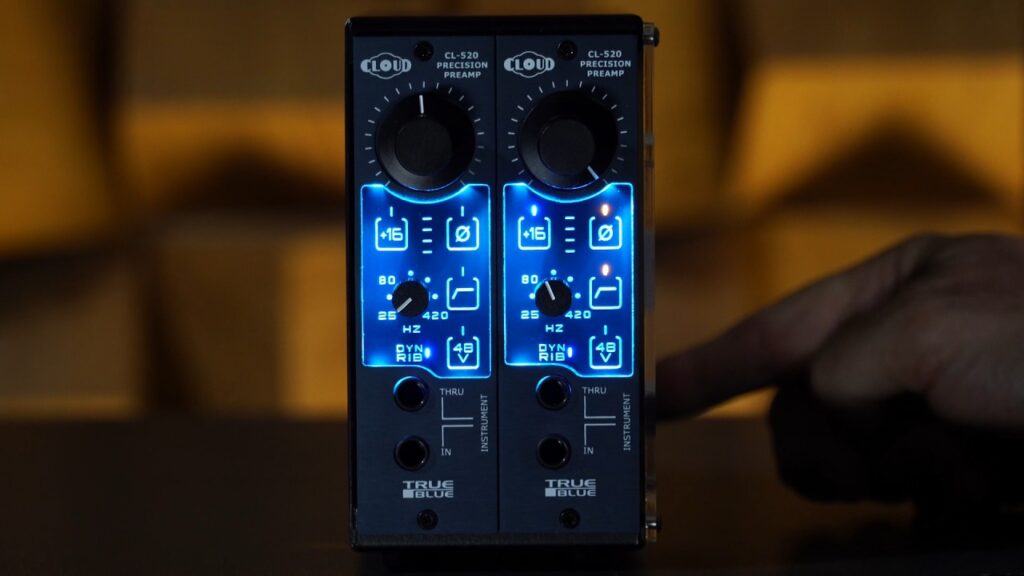
The patent-pending Cloud Touch Interface replaces mechanical switches with capacitive buttons driving telecom-grade relays for Phase Invert, HPF, 16 dB Boost, and 48V Phantom Power.
We appreciate the protective Blink-Delay feature here: it introduces a deliberate latency buffer before engaging phantom power or sudden gain changes, preventing transient spikes that could damage ribbon elements or blow monitors mid-session.
Every gain stage maintains the transformerless rail-to-rail topology’s +28 dBu maximum output ceiling.
Dedicated Dynamic & Ribbon Mode: Optimizing Passive Microphones
Disengaging +48V phantom power doesn’t simply remove DC bias from the signal path, it triggers the CL-520’s Dynamic/Ribbon Mode, a dedicated circuit topology optimized for passive microphone sources.
- Capacitor Bypass: DC blocking capacitors are removed from the input stage, creating a direct-coupled, transformerless signal path that eliminates low-frequency phase shift and improves transient clarity.
- Impedance Optimization: Input impedance increases from 5.5 kΩ to 10 kΩ, reducing capsule loading on ribbon microphones like Coles, Royer, and AEA for extended high-frequency performance.
- Dynamic Mic Compatibility: High-impedance interfacing guarantees dynamic sources like the SM7B deliver full bandwidth without transient compression.
- Distortion Reduction: The rail-to-rail transformerless topology maintains linearity across the preamp’s entire gain range, preserving harmonic integrity and maximizing signal clarity.
Variable High-Pass Filter & FET Instrument DI
The FET instrument DI presents 1 MΩ input impedance via a front-panel 1/4-inch jack, capturing pristine direct signals from bass or guitar without loading pickups.
An unbuffered Thru jack passes the unprocessed signal simultaneously to an amplifier or pedalboard, enabling zero-latency monitoring and parallel tracking.
This adjustable, dual-output configuration maximizes workflow flexibility within a single slot.
Real-World Studio Performance: Tracking Vocals, Acoustic Instruments & Drums
When we pushed the CL-520 on quiet acoustic guitar fingerpicking captured through an AEA R84, the preamp’s -134 dBu EIN proved its worth, even at +70 dB of combined gain, the noise floor remained inaudible against the instrument’s natural room tone.
- Spoken word/intimate vocals: The cloud microphone’s transformerless topology delivered high-quality, uncolored captures, zero harmonic artifacting where 1073-style preamps would impose midrange saturation.
- Acoustic instruments: Nylon-string classical guitar retained full 5 Hz–200 kHz bandwidth transparency, preserving overtone structure no studio transformer chain could match.
- Transients: Snare hits and piano hammers tracked with zero compression artifacts; +28 dBu headroom absorbed peaks effortlessly.
- Contrast: Against API 312-style coloration, the CL-520’s rail-to-rail precision felt clinically resolving, intentionally unforgiving, rewarding pristine source material.
- Continuously variable high-pass filter (6 dB/oct) from 25 to 420 Hz
- Dynamic/Ribbon mode with 10 kOhm input impedance and a capacitance-free signal path
- Cloud Touch Control System with microprocessor-controlled telecoms relays
- Instrument DI input and THRU output on the front panel
- +48V phantom power
Final Verdict: Value, Pros & Cons, and Competitor Comparison
After logging extensive hours with the CL-520 across vocal, acoustic, and drum sessions, we’ve landed on a clear verdict: this preamp isn’t trying to be everything, it’s engineered to do one thing flawlessly, and that’s deliver absolute signal transparency at extreme gain levels.
The True Blue CL-520 delivers +76 dB of clean gain without degradation, outpacing the Grace m501 (+66 dB) and matching the Millennia HV-35’s signal purity while adding a variable HPF and dedicated ribbon mics optimization via 10 kΩ impedance switching.
The built-in DI with Thru expands workflow versatility beyond typical competitors like the Earthworks 521.
Limitations? No harmonic saturation options, and the capacitive touch interface demands acclimation.
For engineers prioritizing uncompromised signal purity and innovation-forward design, the CL-520 earns our unequivocal recommendation.
Frequently Asked Questions
Q: Can the CL-520 Be Powered by Any Third-Party 500 Series Chassis?
A: The CL-520 is designed as a standard single-slot 500 series module, so it’ll slot seamlessly into any API-compatible third-party chassis, Purple Audio, Radial, BAE, delivering pristine, transformerless performance wherever you rack it.
Q: Does the CL-520 Require Recalibration After Extended Continuous Use?
A: The CL-520 doesn’t require recalibration. Its transformerless rail-to-rail topology with 0.1% precision resistors guarantees long-term parametric stability. You’ll maintain consistent CMRR, EIN, and gain accuracy across extended sessions without drift or degradation.
Q: What Is the Warranty Coverage Period for the CL-520?
A: We don’t have the CL-520’s warranty coverage period in our spec documentation. We’d recommend contacting Cloud Microphones directly, they’ll provide precise terms covering this transformerless, capacitive-touch-driven 500 series module’s post-purchase protection.
Q: Are Replacement Capacitive Touch Sensors Available if They Malfunction?
A: We don’t have specific details on replacement capacitive touch sensor availability. We’d recommend contacting Cloud Microphones, they’ll advise on component serviceability, warranty-covered repairs, and whether individual Cloud Touch Interface™ modules can be sourced independently.
Q: Can Two CL-520 Modules Be Linked for Stereo Tracking?
A: The CL-520 doesn’t include a built-in stereo link function. Picture two pristine signal paths running parallel, you’ll need to manually gain-match both modules’ detented knobs and engage identical HPF, phase, and phantom settings for cohesive stereo imaging.
Conclusion
We’ve thrown everything at the CL-520, whisper-thin ribbon signals and scorching hot DI sources alike, and it handles both extremes with remarkable equanimity. Where competing 500 series preamps introduce coloration at high gain stages, the CL-520’s transformerless topology stays ruthlessly transparent.
The Cloud Touch Interface™ feels futuristic yet intuitive; the +76 dB ceiling is overkill until it’s absolutely essential. For engineers prioritizing signal integrity over harmonic character, this preamp’s a no-brainer.
Related Articles
- Rupert Neve 542 Review: Legacy Tape Emulator!
- Elysia xfilter 500 Review: Pro Audio Stereo Equalizer!
- Chandler tg2 500 Review: 500 Series Microphone Preamp!
- SSL G Bus Review: Great 500 Series Compressor Module!
- Radial Workhorse Cube Review: Amazing 500 Series Chassis!
- Pultec EQP-500X Review: Huge 500 Series Program Equalizer!
- SSL Six 500 Series Review: Big Channel Strip in 500!
- Rupert Neve Designs 511 Review: Amazing Mic-Pre!