Lindell Audio 7X-500 Review

- Parallel compression with crossfade control
- High pass sidechain filter
- 3 Step Switched Attack Times
- 3 Step Switched Release Times
Lindell Audio 7X-500 Review
One other brand that is among my favorites when it comes to producing authentic audio equipment. They are giving us another gem. The Lindell Audio 7X-500 delivers authentic 1176-style FET compression through a Class-A discrete signal path with transformer-balanced output, all in a single-width 500 series slot.
We’re impressed by its 20ms attack time, three ratio positions (4:1, 12:1, 100:1), and built-in parallel blend control that eliminates aux bus routing. The 3-position sidechain HPF prevents low-end pumping on bass-heavy sources. Below, we’ll break down each feature so you can decide if it fits your rack.

What Is the Lindell Audio 7X-500 500 Series Compressor?
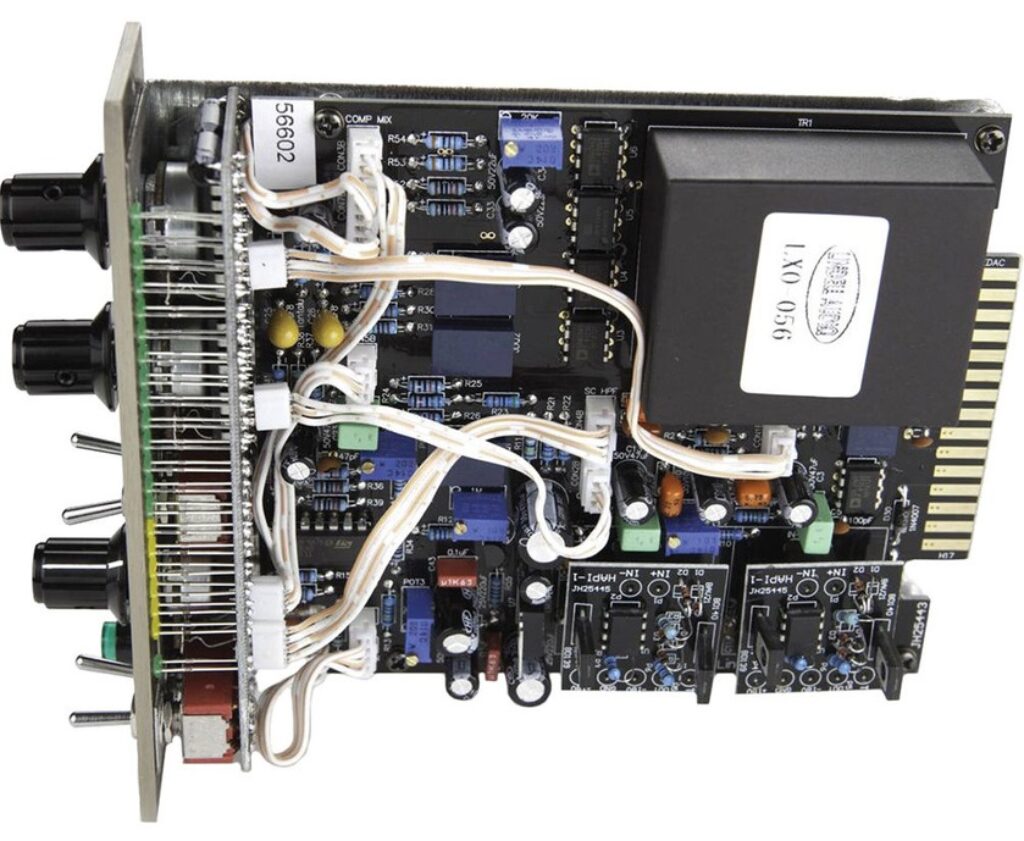
The Lindell Audio 7X-500 packs a full FET compressor/limiter into a single-width 500 series module, drawing just ~80mA from standard ±16V DC rails.
Designed by Tobias Lindell, this 500 series compressor translates classic 1176-style FET peak limiting into an ultra-compact, VPR Alliance-compliant format without sacrificing analog muscle.
At its core, the signal passes through a FET gain reduction element into a Class-A discrete signal path, ensuring minimal phase distortion and maximum harmonic integrity.
The transformer-balanced output stage uses custom Lindell transformers, adding subtle saturation characteristics typical of transformer-coupled designs.
We’re looking at a module that delivers explosive 1176 energy, lightning-fast transient control, analog warmth, and studio-grade dynamics processing, within a single-slot footprint at a budget-friendly price.
How Does the Lindell Audio 7X-500 Sound?
Knowing what’s under the hood is one thing, hearing it hit a mix is another. This compressor delivers raw FET aggression with transformer-saturated weight that channels classic 1176 sound at every ratio setting.
Here’s where the 7X-500 excels across key sources:
- Snare drums: 20ms attack shaves transient peaks while the Class-A path adds explosive snap and harmonic grit.
- Electric bass: 12:1 ratio pins dynamics flat, and the high pass sidechain filter at 100Hz prevents low-end pumping.
- Rock vocals: ALL-BUTTONS-IN mode crushes dynamic range with dense, saturated control.
- Parallel compression: the continuous Blend knob mixes crushed signal against dry, preserving transient detail while stacking analog density.
Every setting delivers immediate, punchy transformation.
Navigating Ratios: From 4:1 to the Legendary 100:1 All-Buttons-In Mode
Three ratio positions on a single toggle switch give the 7X-500 its full dynamic range of behavior, from transparent leveling to total destruction.
At 4:1, you’re gently taming transients with minimal coloration, ideal for vocal riding and bus glue. Push to 12:1, and the FET clamps down hard, delivering aggressive peak control with audible gain reduction character.
The 100:1 mode is where things get explosive. This recreates the classic 1176 “All-Buttons-In” behavior, where the compression circuit fundamentally overdrives itself.
The FET element overshoots transients rather than cleanly catching them, generating harmonic distortion and unpredictable gain reduction artifacts.
We’ve found it devastating on room mics, it squashes ambience into a dense, saturated wall that breathes violently between hits, transforming any drum room into a weapon.
- FET-based technology sounds eerily reminiscent of classic compressors from the late ’60s
- 3-step switched attack and release times make dialing in the perfect dynamics easy
- 3-mode (off, 100Hz, and 300Hz) highpass sidechain filter lets you focus your dynamics
- Choose from mild 4:1, heavy 12:1, and “all-in” 100:1 compression ratios
Onboard Parallel Compression: The Blend Control Advantage
Built-in parallel compression is what raises the 7X-500 from a straightforward FET compressor into a genuinely flexible mix tool. The continuous dry/wet blend control lets you dial in exact ratios of crushed and uncompressed signal directly at the output stage, no aux buses, no routing intricacies.
Here’s the engineering advantage in practice:
- Set the ratio to 100:1 all-buttons-in mode with fast attack.
- Drive the input hard to achieve maximum gain reduction.
- Dial the blend control to 20-30% wet, preserving transient-rich dry signal.
- Adjust the output to level-match against your bypass.
This parallel compression approach delivers explosive density beneath natural dynamics.
You’re stacking compressed energy under untouched peaks, achieving impact that serial compression simply can’t replicate at this price point.
Sidechain HPF & 3-Way Timing Switches
The 3-way attack and release toggles complement this sidechain filter precisely. Attack options span 20ms to 5ms; release ranges from 50ms to 1.5s.
We’re selecting from nine distinct timing combinations per ratio setting, each interacting differently depending on which sidechain filter position you’ve committed to upstream of the detector.
Is the Lindell Audio 7X-500 Worth It? (Final Verdict)
So where does the Lindell Audio 7X-500 land in the current 500 series compressor market?
It’s the most affordable API 500 series FET module delivering classic 1176 DNA with modern workflow improvements. Home studio owners and project engineers get transformer-saturated compression with built-in parallel blending, features typically reserved for units at twice the price.
The 7x-500 compressor earns its spot for four key reasons:
- 20ms attack captures transients faster than most competing modules
- 100:1 all-buttons-in mode delivers unmistakable crush character
- Continuous blend control eliminates external parallel routing
- 3-position sidechain HPF prevents low-end pumping without outboard filtering
If you’re chasing classic FET energy on drums, bass, or vocals without breaking your budget, this module belongs in your lunchbox.
Frequently Asked Questions
Q: Does the Lindell Audio 7X-500 Require a Specific 500 Series Chassis?
A: As a single-width unit, you’ll maximize rack density while accessing its FET compression, Class-A discrete amplifier path, and transformer-balanced output.
We recommend verifying your chassis meets API 500 series specifications for peak performance.
Q: How Much Current Does the 7X-500 Draw From the Lunchbox?
A: The 7X-500 won’t break the bank on your power budget, it draws approximately 80mA from standard +/-16V DC rails.
We’ve found this minimal current consumption means you can populate a fully loaded lunchbox without worrying about overtaxing your chassis’s power supply.
When you’re stacking multiple 500 series modules, every milliamp counts, and the 7X-500’s efficient Class-A discrete amplifier path and FET gain element keep power demands impressively lean.
Q: Can You Stereo-Link Two 7X-500 Units for Bus Compression?
A: We can’t confirm a stereo-link feature on the 7X-500, it’s not documented in the unit’s spec sheet.
You’ll find 3-way toggle switches for ratio, attack, and release, continuous input/output knobs, a sidechain HPF, and a parallel blend control, but there’s no dedicated link connector or sidechain bus output.
For true stereo bus compression, you’d need to investigate Lindell’s other products or a unit specifically engineered with link functionality.
Q: What Type of Transformers Does the Lindell Audio 7X-500 Use?
A: The 7X-500 uses custom Lindell transformers on its balanced output stage, purpose-built to complement the unit’s Class-A discrete amplifier path and FET gain reduction topology.
These aren’t off-the-shelf components, they’re designed in-house to deliver the harmonic saturation and impedance characteristics that define the 7X-500’s aggressive tonal signature.
We’d highlight how they contribute meaningful coloration, especially when you’re driving the input hard into higher ratio settings.
Q: Is the Lindell Audio 7X-500 Compatible With API Lunchbox Formats?
A: Yes, the 7X-500 fits any standard 500 series chassis, including API lunchboxes.
We love how Lindell’s packed a FET compressor with Class-A discrete amplification and transformer-balanced output into this compact format, letting you integrate serious 1176-style processing directly into your modular signal chain.
Conclusion
The Lindell Audio 7X-500 is a sledgehammer wrapped in velvet, its Class-A discrete signal path and transformer-balanced output deliver that unmistakable FET bite without devouring your budget.
We’ve found its switched attack/release times, sidechain HPF, and onboard blend control give you surgical control over dynamics that punches well above its price class. If you’re craving 1176-inspired compression in a single-width 500 series slot, this compressor earns its rack space.
Related Articles
- Rupert Neve 542 Review: Legacy Tape Emulator!
- Elysia xfilter 500 Review: Pro Audio Stereo Equalizer!
- Chandler tg2 500 Review: 500 Series Microphone Preamp!
- SSL G Bus Review: Great 500 Series Compressor Module!
- Radial Workhorse Cube Review: Amazing 500 Series Chassis!
- Pultec EQP-500X Review: Huge 500 Series Program Equalizer!
- SSL Six 500 Series Review: Big Channel Strip in 500!
- Rupert Neve Designs 511 Review: Amazing Mic-Pre!