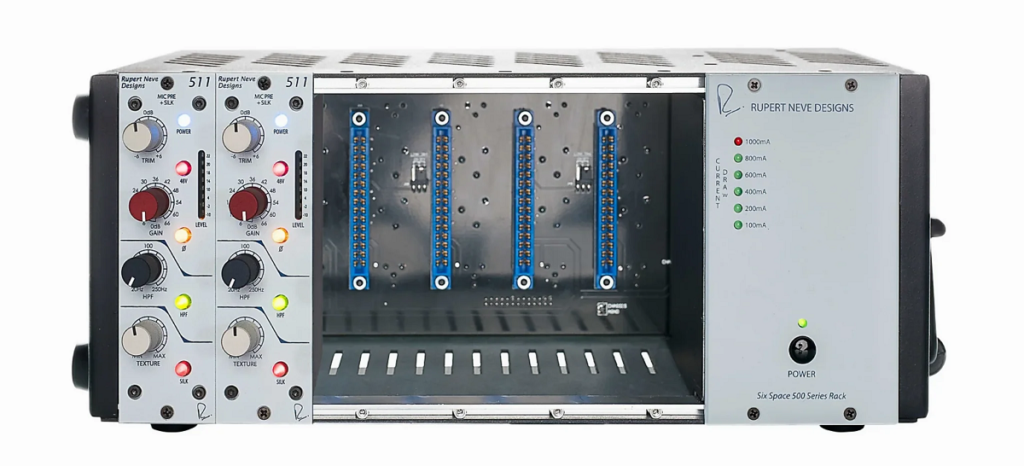
Rupert Neve Designs 511 Review

- 1 Channel Mic preaamp with 500 Module formfactor
- +48V Phantom power can switched On and Off
- 8 Segment LED Level-Meter
Time for another great review for a great unit by RND. This preamp will probably be in your chassis for a long time if you decide to go for it.
The Rupert Neve Designs 511 delivers a transformer-coupled, Class-A preamp with 66dB of stepped gain and a sweepable HPF (20–250Hz) in a single 500-series slot. We’ve found its baseline is surgically transparent, preserving transient fidelity without coloration.
The real standout is the variable Silk Red circuit, which manipulates negative feedback to introduce musical 2nd and 3rd order harmonics up to 2% THD. Below, we’ll break down exactly how its Texture control, tonal performance, and 1073 comparisons stack up.

What’s Inside the Rupert Neve Designs 511?
The sweepable high pass filter, derived from the Portico 5012, rolls off continuously from 20Hz to 250Hz at 12dB/octave, essential for eliminating proximity effect and low-end rumble.
An 8-segment LED meter monitors output levels pre-Silk.
The module’s power requirement sits at 100mA from standard +/-16V DC rails, maintaining compatibility across 500 series enclosures.
How Does the RND 511 Sound?
How does a modern Neve design actually translate to raw sonic performance? The 511 mic preamp delivers razor-sharp transient fidelity with zero coloration at baseline, unlike a vintage Neve, it’s clinically transparent until you engage the silk circuit.
Here’s what we’ve observed across sources:
- Vocals: Pristine high-frequency air with precise sibilance definition; the high pass filter at 80–120Hz eliminates proximity buildup without phase smearing.
- Acoustic guitar: Fast transient attack captures pick articulation and body resonance with exceptional low-end punch and zero muddiness.
- Line-level synths: At 0dB gain, the transformer-coupled output stage preserves harmonic integrity while adding subtle dimensional weight.
The 511’s uncolored baseline gives engineers a surgically accurate foundation before any saturation processing.
The Secret Weapon: Unpacking the Silk Red and Texture Circuit
Beyond that transparent baseline lies the 511’s most distinctive engineering feature: the Silk Red circuit with variable Texture control. Derived from the Portico II Channel, this silk control manipulates negative feedback within the custom output transformer to introduce progressively increasing harmonic distortion.
When you engage red silk mode, you’re actively reducing the transformer’s negative feedback loop, allowing 2nd and 3rd order harmonics to bloom, particularly across upper-mids and high frequencies.
The texture control gives you continuous variable saturation, scaling THD from a pristine 0.015% to a fully saturated 2% at maximum rotation. This isn’t modeled saturation; it’s real transformer-core behavior generating authentic vintage warmth through analog nonlinearity.
We’re talking genuine iron-driven harmonics that transform the 511 from a surgically clean modern preamp into a richly saturated tracking instrument.
Rupert Neve Designs 511 vs. Classic 1073 Architecture
While the 511 carries Rupert Neve’s name, it shares almost nothing architecturally with the classic 1073 preamp he designed in 1970. The Neve Designs Portico 511 reflects modern high-precision engineering, stepped gain, low-noise topology, and controlled saturation via Silk Red.
Vintage designs like 1073-style preamps deliver thick, transformer-heavy coloration by default.
Key architectural differences:
- Transient response: The 511’s circuit yields razor-sharp transients; the 1073 rounds them with slower slew rates
- Harmonic content: The 1073 imparts fundamental even-order saturation, while the 511 remains transparent until texture is increased
- Filtering: The 511’s sweepable 20-250Hz HPF outclasses the 1073’s fixed-frequency filter options
Each preamp serves distinct mixing philosophies, the 511 prioritizes surgical control, whereas the 1073 delivers character through circuit-level inefficiency.
Who Should Buy the Rupert Neve Designs 511?
Understanding the 511’s architectural strengths narrows down exactly who benefits most from this module. Home studio owners upgrading from built-in interface preamps gain immediate access to Rupert Neve’s transformer-coupled topology, stepped 66dB gain staging, and the Silk Red saturation circuit, a quantum leap in signal chain quality within the compact 500 series format.
Professional engineers building multi-channel tracking lunchboxes appreciate the Rupert Neve Designs 511 as a mic preamp delivering +23dBu headroom, precise 6dB gain increments, and sweepable HPF across every slot.
For producers seeking a versatile workhorse, the 511’s dual-mode operation, pristine at 0.015% THD or harmonically saturated at 2% THD, delivers both clean and colored signals from a single module. It’s engineered flexibility without compromise.
- High Pass Filter can be set, 20 – 250 Hz
- Trim and Gain-Control
- Polarity is reversible/can be switched
- Silk Mode
- Required voltage/power: +/-16VDC 100 mA
Is the RND 511 Worth It? Final Verdict
So does the RND 511 justify its price point against competing 500 series preamps? Absolutely. This mic preamp delivers Rupert Neve designs 511’s hallmark transformer-coupled topology at a competitive price that undercuts most comparable 500 series modules.
Yes, you’ll sacrifice:
- Internal instrument DI input for direct guitar/bass tracking
- Blue Silk mode for low-end harmonic improvement
- Dual-mode Silk switching found in higher-tier Portico units
These omissions are minor.
The RND 511’s flexibility, 66dB stepped gain, sweepable HPF, variable Silk Red/Texture, combined with its exceptionally low noise floor and build quality make it a benchmark mic preamp.
You’re getting Neve-grade saturation control, precision gain staging, and transformer-driven harmonics in a single-width format that punches well above its price class.
Frequently Asked Questions
Q: Does the Rupert Neve Designs 511 Require a Specific 500 Series Chassis?
A: No, the RND 511 doesn’t require a proprietary chassis, it’s a standard single-width 500 series module that slides into any VPR Alliance-compliant rack.
Picture that transformer-coupled signal path humming alongside your favorite modules.
We’ll note it draws 100mA from the ±16V DC rails, so you’ll want to verify your chassis’s power supply headroom.
Any well-spec’d lunchbox or rack delivering adequate current per slot will release its full +23dBu output potential.
Q: Can the RND 511 Be Used as a Standalone DI Box?
No, the RND 511 isn’t a standalone DI box, it’s a transformer-coupled mic preamp requiring a 500 series chassis for ±16V DC power.
However, you can feed line-level signals directly by setting the gain to 0dB, effectively bypassing additional amplification.
For true DI functionality, impedance bridging from instrument-level sources, you’d need a dedicated DI upstream.
The 511’s strength lies in its Silk Red saturation and pristine preamp topology, not impedance conversion.
Q: What Is the Warranty Period for the Rupert Neve Designs 511?
We’d love to give you a definitive answer, but the warranty period for the Rupert Neve Designs 511 isn’t specified in our technical documentation, and we’d move mountains to find it for you.
We recommend contacting Rupert Neve Designs directly or consulting your authorized dealer for precise warranty terms, coverage exclusions, and transferability details.
They’ll provide the most accurate, up-to-date information regarding your specific unit’s protection plan.
Q: How Much Power Does the RND 511 Draw From the Chassis?
A: The RND 511 draws 100mA from your 500 series chassis’s +/-16V DC rails.
That’s a modest current footprint, letting you populate a fully loaded lunchbox without stressing the PSU’s total current budget.
We’d recommend tallying each module’s draw against your chassis spec, some power supplies cap out around 1200-1600mA total.
With efficient consumption like this, you’ll have headroom to pair the 511 alongside power-hungry compressors and EQs.
Q: Is the Rupert Neve Designs 511 Compatible With Ribbon Microphones?
Yes, the RND 511 is fully compatible with ribbon microphones.
We’ve got switchable +48V phantom power, just make sure it’s disengaged before connecting your ribbon, as phantom voltage can damage delicate ribbon elements.
With 66dB of gain in 6dB stepped increments plus a ±6dB Trim, you’ll gain sufficient headroom for low-output ribbons.
Imagine the Silk Red circuit wrapping your ribbon’s natural warmth in harmonically rich transformer saturation, pure innovation.
Conclusion
We’ve pushed the 511’s custom-wound transformer, stepped gain architecture, and Silk Red saturation circuit through every scenario we could devise, and like Prometheus bringing fire to mortals, Rupert Neve has delivered flagship-caliber harmonic coloration to the 500 series format.
The THD characteristics, transient response, and headroom specifications genuinely rival rackmount units at twice the price point. If your lunchbox has an empty slot, we’d fill it without hesitation.
Related Articles
- Rupert Neve 542 Review: Legacy Tape Emulator!
- Elysia xfilter 500 Review: Pro Audio Stereo Equalizer!
- Chandler tg2 500 Review: 500 Series Microphone Preamp!
- SSL G Bus Review: Great 500 Series Compressor Module!
- Radial Workhorse Cube Review: Amazing 500 Series Chassis!
- Pultec EQP-500X Review: Huge 500 Series Program Equalizer!