SSL Six 500 Series Review

- Channel strip with SuperAnalogue microphone preamplifier and 5-step LED display
- 48 V phantom power
- Phase and HPF switch
When we say 500 series are compact and useful, probably the first item that comes to mind is this one. The SSL Six 500 series modules pack the SiX console’s SuperAnalogue preamp, 2-band EQ, and 2:1 compressor into a standard 500 series slot.
We’re impressed by the punchy, transparent signal path, the 75Hz HPF for rumble control, and the front-panel 1/4-inch Hi-Z DI input with 1MΩ impedance bridging. The 5-segment LED meter keeps gain staging intuitive. Below, we’ll break down how each module performs across tracking and mixing scenarios.

What’s Inside the SSL Six 500 Series?
Beyond the core trio, the SSL Six Channel includes essential utility features: a 75Hz high pass filter for cleaning low-end rumble pre-processing, and a 5-segment LED output meter for real-time level monitoring.
Every component maximizes functionality within the compact 500 series form factor.
How Does the SSL Six 500 Series Sound?
How does the SSL Six Channel actually sound in practice? The SuperAnalogue preamp delivers ultra-clean transparency with exceptionally low distortion, yielding a punchy, wide-open sonic character that preserves transient detail without coloration.
This is the SSL Six’s defining trait, headroom that lets sources breathe.
The 2-band EQ employs wide-Q curves that shape vocals and instruments musically rather than surgically, adding presence or weight without phase artifacts.
These channel processing features guarantee tonal shaping remains natural and mix-ready.
Push the 2:1 compressor hard and it responds with smooth, progressive gain reduction, thickening dynamics without obvious pumping.
It’s subtle enough for tracking yet assertive when driven.
Together, these elements deliver versatile performance that scales from delicate acoustic work to aggressive bus processing.
SSL Six 500 Series Vs the Original SSL Six
Where workflow diverges is modularity. The 500 series channel strip format lets you deploy channels independently, chain them with third-party modules, or integrate into existing racks without committing to a fixed console topology.
You’re gaining signal path flexibility without sacrificing SSL’s core analog DNA, a meaningful advantage for engineers building customized, scalable processing environments.
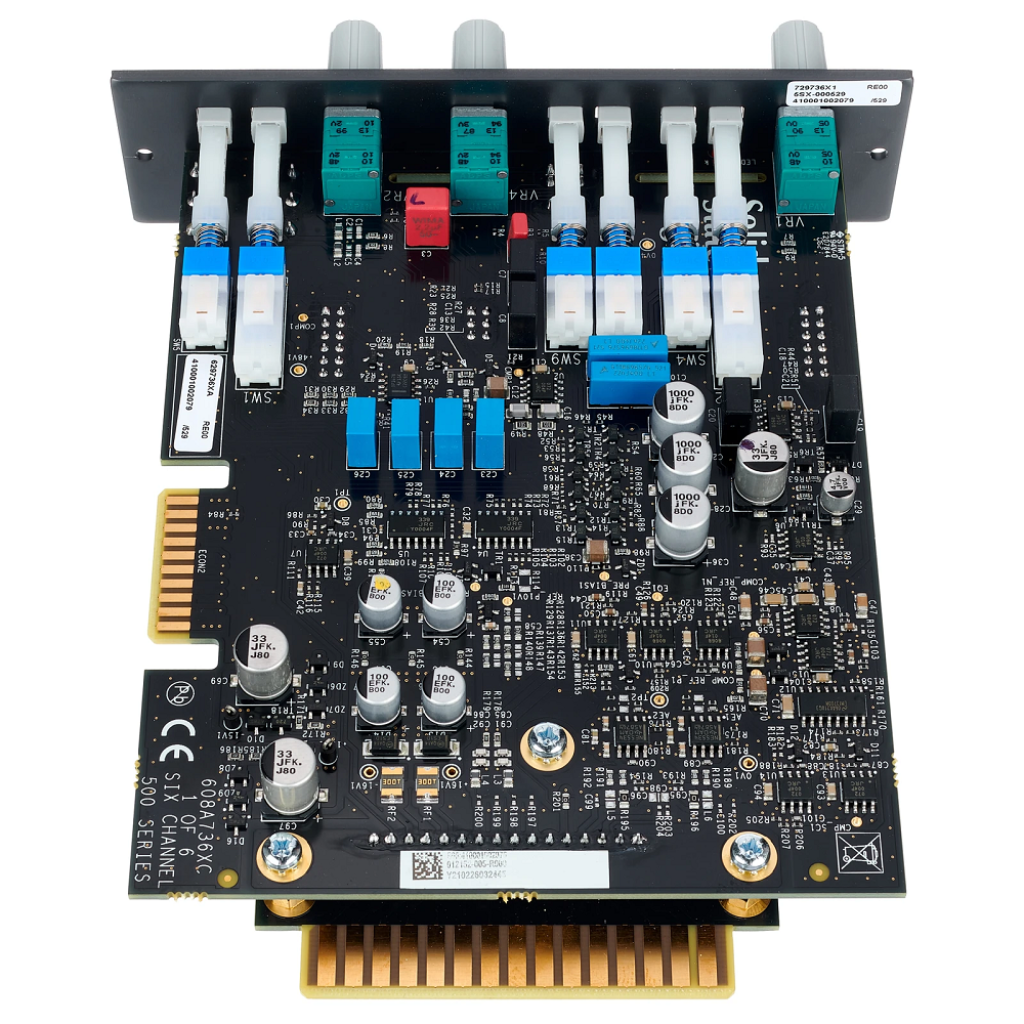
Front-Panel Direct Injection: The 1MΩ Hi-Z Advantage
The SSL Six 500 includes a front-panel 1/4-inch TRS input that doubles as a high-quality direct injection stage when you engage the 1MΩ Hi-Z switch. This direct injection circuit functions as a high-quality built-in DI box, presenting sufficient impedance to prevent passive electric guitar and acoustic pickups from losing high-frequency detail due to capacitive loading.
- Impedance bridging: The 1 Megohm Hi-Z switch raises input impedance to 1MΩ, ensuring minimal signal attenuation across the audible spectrum from high-impedance sources like single-coil and humbucker pickups.
- Bass tracking: Low-frequency instruments benefit from preserved transient integrity without the tonal coloration of external DI boxes.
- Signal path efficiency: Eliminating an external DI removes an additional gain stage, reducing noise floor and maintaining phase coherence.
Who Should Buy the SSL Six 500 Series?
So who exactly benefits most from the SSL Six 500‘s feature set? Mobile recordists gain a channel-ready mic preamp that eliminates the need for an external DI box, thanks to the front-panel Hi-Z input handling high impedance sources directly.
Home project studio owners upgrading budget interface preamps will immediately notice the SSL Six mixer-grade signal path delivering versatile performance across condenser, dynamic, and ribbon microphones.
Engineers demanding an intuitive, fast-acting tracking strip benefit from the streamlined gain staging, polarity invert, and phantom power switching, all accessible without menu-diving.
The module’s compact 500-series footprint means you’re deploying SSL’s SuperAnalogue topology wherever your rack travels.
If you’re chasing broadcast-grade transparency with minimal signal chain intricacy, this module delivers precisely that.
- Separate instrument/line input on front panel with Hi-Z switch (1MO)
- Switchable 2-band EQ with bell and shelving characteristics per band
- Switchable ‘Single Knob Compressor’ with threshold control and 3-step LED display
- Preamp gain: Variable from +6 to +72dB (Mic), -3 to +63dB (Line)
- Construction: API series 500 format, requires a 500 slot
Are the SSL Six 500 Modules Worth It?
Ultimately, do the SSL Six 500 modules justify their price-to-performance ratio? We’d argue yes. The Six CH channel strip delivers SSL’s unique circuitry at a fraction of SSL’s Six console pricing, making world-class sonic fidelity accessible within the 500 series ecosystem.
Consider the trade-offs:
- 2-band EQ limitation: Restricts surgical frequency sculpting compared to 4-band parametric alternatives
- Preset compressor with features: Fixed ratio/attack/release values reduce dynamic processing flexibility versus fully variable designs
- Versatile performance at scale: Stacking multiple units creates a modular console workflow with genuine SSL DNA
The competitive price point effectively neutralizes these constraints. You’re acquiring authenticated SSL signal path topology, not an emulation.
For innovation-driven engineers, that’s a decisive value proposition.
Frequently Asked Questions
Q: How Much Does the SSL Six 500 Series Cost?
A: We’ve seen the SSL SiX 500 Series modules priced around $300-$500 depending on the specific configuration and retailer.
You’ll want to factor in whether you’re grabbing the channel strip, bus compressor, or both modules separately.
Street prices fluctuate, so we’d recommend checking authorized dealers like Sweetwater and Thomann for current MAP pricing.
Q: Where Can I Buy the SSL Six 500 Series?
A: You can snag the SSL SiX 500 Series from virtually every pro audio retailer on the planet!
We’d recommend checking authorized dealers like Sweetwater and Thomann for guaranteed authentic units with full warranty coverage.
You’ll also find them on Reverb.com’s marketplace for competitive pricing.
We’d strongly advise purchasing through SSL’s certified dealer network to guarantee you’re getting legitimate firmware revisions and factory-calibrated signal path specifications.
Q: Does the SSL Six 500 Series Come With a Warranty?
A: Yes, the SSL SiX 500 series modules typically come with a manufacturer’s warranty.
We’ve found that SSL offers a standard one-year warranty covering defects in materials and workmanship.
If you’re purchasing through authorized dealers, you’ll often get additional support and streamlined RMA processes.
We’d recommend registering your unit directly with SSL post-purchase to guarantee full coverage.
Check with your retailer for any extended warranty options they might offer.
Q: Is the SSL Six 500 Series Compatible With All 500-Series Chassis?
A: Yes, the SSL Six 500 Series is compatible with any standard VPR Alliance-compliant 500-series chassis.
Coincidentally, that’s the same universal spec we’ve been championing across our entire modular lineup. You’ll find it conforms to the standard pinout configuration, power rail requirements, and form factor dimensions.
We recommend verifying your chassis supplies adequate current per slot, as the module’s processing circuitry can draw near maximum thresholds during high-headroom operation.
Q: What Power Requirements Does the SSL Six 500 Series Need?
A: The SSL SiX 500 series modules require standard VPR Alliance–compliant ±16V rails and +48V phantom power, drawing current within the 500-series spec of 130mA per slot.
We’d recommend ensuring your chassis delivers clean, regulated power with minimal ripple to maximize the module’s SNR and headroom.
If you’re running a fully loaded rack, verify your PSU’s total current capacity won’t sag under load, that’s critical for maintaining SSL’s renowned sonic integrity.
Conclusion
We’ve dissected the SSL Six 500 series modules, and the verdict’s clear—these units deliver flagship SuperAnalogue™ topology in a 500-format footprint. The 1MΩ Hi-Z DI, pristine signal path, and that unmistakable SSL headroom make them indispensable for serious engineers.
Can you really justify not having SSL-grade preamps and channel strips in your lunchbox? If you’re chasing broadcast-quality gain staging with minimal THD+N, these modules absolutely deliver the goods.
Related Articles
- Rupert Neve 542 Review: Legacy Tape Emulator!
- Elysia xfilter 500 Review: Pro Audio Stereo Equalizer!
- Chandler tg2 500 Review: 500 Series Microphone Preamp!
- SSL G Bus Review: Great 500 Series Compressor Module!
- Radial Workhorse Cube Review: Amazing 500 Series Chassis!
- Pultec EQP-500X Review: Huge 500 Series Program Equalizer!