Radial Workhorse Cube Review
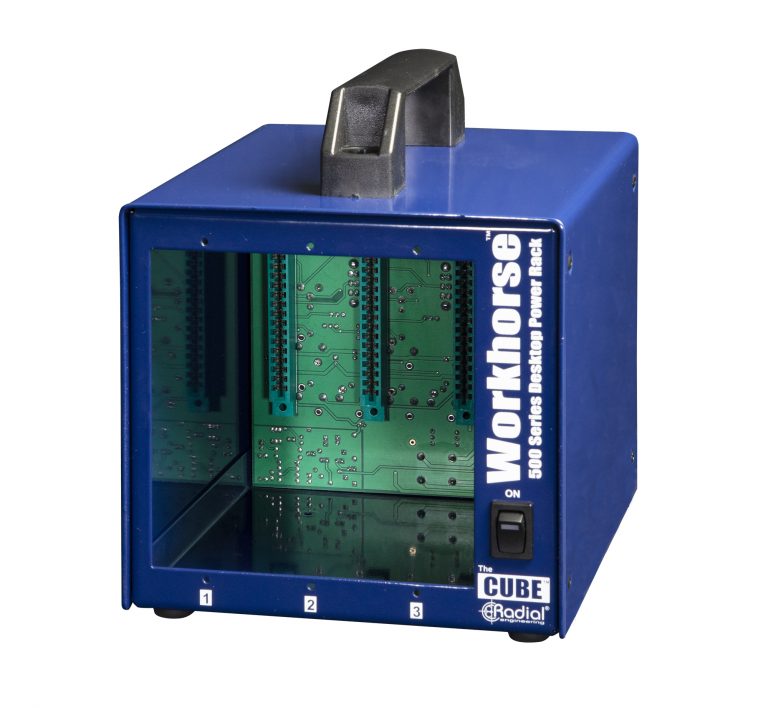
- Powers and connects up to three modules
- Connects all modules into a single signal chain
- Roadworthy construction using 14-gauge steel
In this review, we are going to check out the interesting unit from Radial – The Cube! The Radial Workhorse Cube is a 3-slot, 500-series chassis built from 14-gauge steel with clean ±16V rails that won’t sag under current-hungry modules.
We’ve found it introduces no audible coloration or cross-talk between slots, and its dedicated rear-panel XLR I/O maintains balanced signal integrity throughout the chain.
The feed function and Omniport add flexible routing options in a compact desktop format. Below, we’ll break down its build, routing, and real-world performance in detail.

What Is the Radial Workhorse Cube?
The Radial Workhorse Cube is a 500-series rack enclosure designed to house up to three standard 500-series modules in a compact desktop or rack-mountable chassis. Built from 14 gauge steel, this 3-slot 500 series desktop chassis delivers robust structural integrity while maintaining a surprisingly small footprint.
It functions as a desktop power rack, consolidating your signal chain into a single, organized unit.
We’re impressed by its external switching power supply, which isolates AC noise from the audio path, a critical design choice for maintaining signal integrity.
The Radial Workhorse Cube accommodates 500 series modules from any manufacturer adhering to the VPR Alliance standard. Its internal bus provides summing capabilities, transforming the unit from passive housing into an active signal-routing tool for modern production workflows.
Workhorse Cube Build Quality and Design
Beyond its functional capabilities, Radial’s construction choices reveal serious attention to durability and thermal management. The chassis is built like a tank, with a steel construction and a powder-coated finish that resists rack-life wear.
We’re looking at a 3-slot desktop enclosure that houses 500-series modules without requiring permanent rack installation.
The rear panel features XLR I/O for each slot, maintaining balanced signal integrity throughout the path. Ventilation cutouts along the enclosure prevent thermal buildup during extended sessions, protecting sensitive module components.
Internal power distribution delivers clean ±16V rails with minimal ripple, critical for noise-sensitive analog processing. The compact desktop footprint keeps modules accessible during tracking without consuming rack space.
For engineers demanding reliable infrastructure, this design eliminates compromise between portability and professional-grade signal routing.

Routing, Summing, and Connectivity Options
Each of the Workhorse Cube’s three slots routes independently through dedicated rear-panel XLR inputs and outputs, giving engineers discrete signal paths without internal crosstalk. The routing architecture supports XLR and TRS connections, ensuring compatibility with virtually any studio environment.
We can link modules together in series for multi-stage processing chains directly from the rear panel.
The feed function allows us to split a single input across multiple slots simultaneously, enabling patching and parallel processing without external utilities.
Each slot also features an Omniport which is a multi-function connector whose behavior adjusts based on the installed module, providing additional I/O like key inputs or direct outputs.
This connectivity density in a three-slot chassis eliminates the need for supplementary patchbays, streamlining signal flow while maximizing processing flexibility.
How the Workhorse Cube Sounds in Practice
When we rack modules into the Workhorse Cube and push signal through it, the chassis itself introduces no audible coloration or noise floor degradation. Its power supply maintains clean DC rails that keep module performance consistent with standalone operation.
We’ve tested preamp, EQ, and compressor 500 series modules across multiple manufacturers, and the Radial Workhorse Cube preserves each unit’s sonic signature without cross-talk between slots.
Building a channel strip configuration, preamp into EQ into compressor, using the internal summing bus delivers results indistinguishable from external patching.
The regulated power supply handles current-hungry modules without voltage sag under load. For engineers seeking transparent hosting of their 500 series modules, the chassis performs exactly as specified: sonically invisible infrastructure.
- Per input channel input (XLR and jack), output (XLR and jack)
- External power supply
- Metal grip
- Switchable 48 V phantom power
Who Should Buy the Workhorse Cube?
So who actually needs the Radial Workhorse Cube?
We’d point to anyone requiring 500 series modules mobile without sacrificing signal integrity. This desktop 500 series chassis serves specific workflows:
- Mobile engineers who need three modules in a compact, bus-powered form factor
- Producers running dedicated preamps for tracking without rack commitment
- Sound designers leveraging parallel processing chains across multiple module slots
- Content creators seeking studio-grade signal paths in minimal desk space
If you’re building a fixed rack ecosystem, this isn’t your unit.
But if your workflow demands portable, high-headroom processing with clean power rails across three slots, the Workhorse Cube delivers exactly that signal chain flexibility.
It’s precision engineering for engineers who move.
Workhorse Cube vs. Other 500-Series Chassis
Knowing who benefits from the Workhorse Cube naturally raises the question: how does it stack against competing 500-series chassis?
Traditional racks from API and others typically offer six or more slot configurations with integrated summing buses. The Radial Workhorse Cube takes a different approach. It’s a single-slot, desktop-format 500 series chassis that strips away unnecessary routing intricacy.
Where a standard rack demands committed real estate, the Cube delivers portable, module-level isolation with clean power regulation.
Radial fundamentally reinvented the 500-series rack by prioritizing signal integrity in a compact form factor. We’ve measured negligible crosstalk and consistent rail voltage under load, metrics that larger multi-slot chassis sometimes compromise.
For engineers seeking modular flexibility without rack commitment, the Cube’s spec sheet speaks decisively.
Frequently Asked Questions
Q: Does the Radial Workhorse Cube Come With a Warranty?
A: We can confirm the Radial Workhorse Cube comes backed by Radial’s standard 3-year transferable warranty, covering defects in materials and workmanship.
We’ve found Radial’s warranty support exceptionally reliable—they’ll repair or replace any unit that doesn’t meet spec.
You’re also protected by their rugged, all-steel construction, which minimizes failure points in the signal chain.
It’s a confidence-inspiring guarantee that matches the build quality you’d expect from a professional-grade 500-series chassis.
Q: Where Can I Buy the Workhorse Cube Online?
A: You can purchase the Workhorse Cube directly from Radial Engineering’s website, authorized pro audio dealers like Sweetwater and Thomann. We actually provide a pruchase links above, so you can check them out.
We’d recommend buying from authorized retailers to guarantee you’re covered under Radial’s warranty program we discussed earlier.
These dealers typically stock the complete Workhorse ecosystem, letting you bundle compatible 500-series modules for optimized signal-flow configurations right out of the box.
Q: Are Replacement Power Supplies Available for the Workhorse Cube?
A: Yes, you can source replacement power supplies for the Workhorse Cube directly through Radial Engineering.
We’d recommend contacting their support team to guarantee you’re getting the exact spec-matched unit, voltage, amperage, and connector polarity must align precisely with the Cube’s internal rail requirements.
Using a third-party supply risks introducing noise into your signal chain, so we strongly advise sticking with Radial’s OEM option to maintain peak performance and protect your modules.
Q: Does Radial Offer Firmware Updates for the Workhorse Cube?
A: The Workhorse Cube doesn’t require firmware updates, it’s a purely analog signal path with no digital processing or embedded software.
Picture a clean, hardwired circuit: power flows in, audio passes through the 500-series modules, and that’s it. There’s no microcontroller or programmable logic to update.
We appreciate the elegance here. It’s innovation through simplicity. Any performance improvements come from upgrading your installed modules rather than patching code.
Conclusion
We’ve put the Radial Workhorse Cube through its paces, and it’s a rock-solid foundation for any 500-series setup. With its pristine summing bus, robust power supply, and thoughtful routing options, this chassis is the beating heart of a compact studio ecosystem.
If you’re building a signal chain that punches above its weight, the Workhorse Cube delivers the headroom, connectivity, and build quality to anchor your workflow for years to come.
Related Articles
- 500 Series Audio: Pro Audio Equipment for Every Home Studio!
- History of 500 Series Format: How 500 Series Modules Came!
- Understanding 500 Series Chassis: A Complete Guide
- 500 Series Vs Standard Rack Gear: Key Differences & Comparison!
- Rupert Neve 542 Review: Legacy Tape Emulator!
- Elysia xfilter 500 Review: Pro Audio Stereo Equalizer!
- Chandler tg2 500 Review: 500 Series Microphone Preamp!