Heritage Audio 500 Series
Much like a well-stocked toolbox defines a craftsman’s capability, Heritage Audio’s 500 Series lineup gives us modular flexibility across preamps, EQs, and dynamics processing.
We’re looking at units spanning from the LANG 312L’s transformer-coupled topology to the Grandchild 670’s vari-mu compression, all in a standardized API format. With eight distinct modules and rack options to examine, there’s more under the hood here than the spec sheets suggest.

Heritage Audio LANG 312L
The Heritage Audio LANG 312L packs vintage NY-style American console preamp architecture into a single 500-series slot, delivering up to 90 dB of gain through a fully discrete Class-A signal path.
Its vintage design centers on a custom mu-metal shielded input transformer paired with a custom Cinemag output transformer, transformer quality that defines its thick, punchy sonic characteristics.
The massive gain range guarantees mic compatibility across all source types. A front-panel “Ribbon & SM7” push button engages +25 dB of internal boost while shifting input impedance from 1.2kΩ to 10kΩ, optimizing energy transfer for low-output passive ribbons and dynamics.
Additional controls include a Neutrik Combo XLR/instrument DI jack (2MΩ impedance), 20 dB pad, 48V phantom power, and phase reverse.

You Can Buy This Unit On The Links Below:
Heritage Audio 73 Jr. II
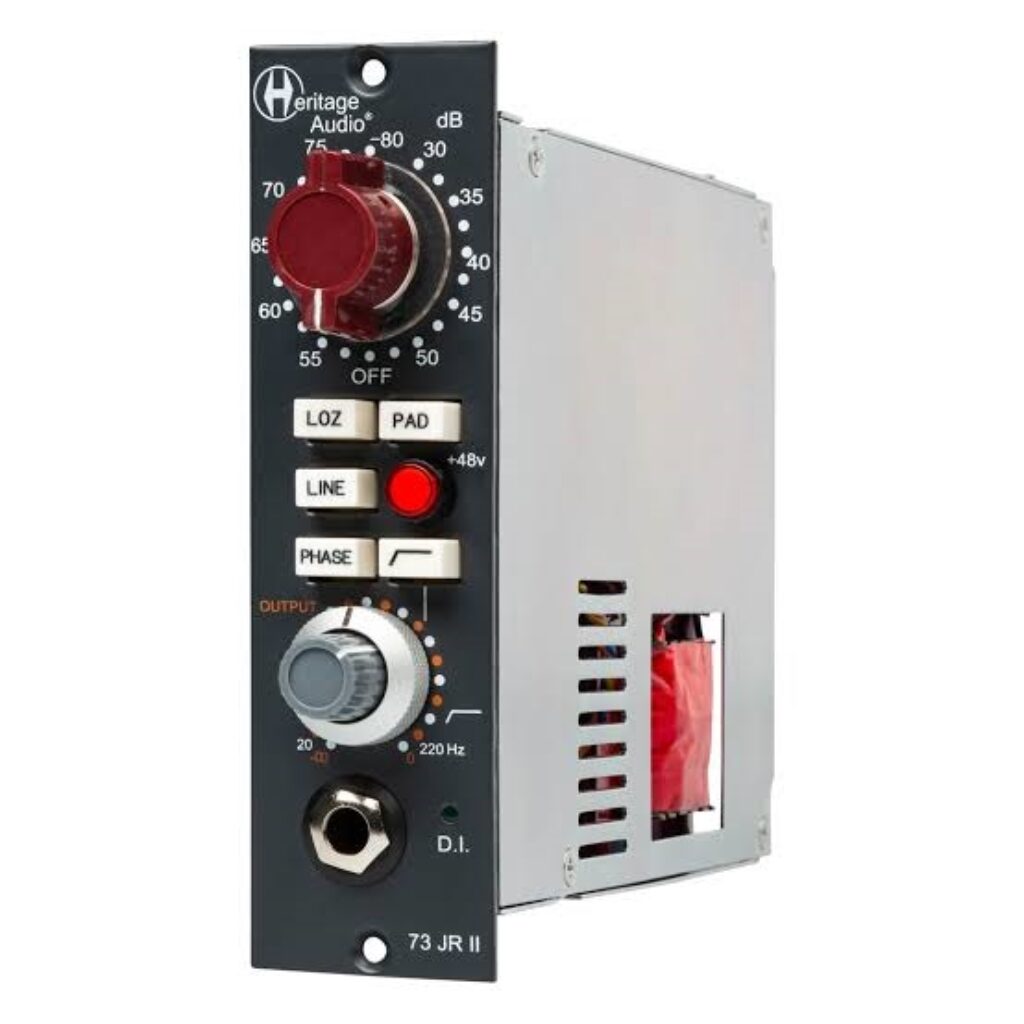
Heritage Audio’s 73 Jr. II delivers authentic 1073-style Class-A topology in a single-slot 500-series format. Its discrete component design employs genuine UK-made Carnhill input and output transformers, ensuring exceptional transformer quality that captures the harmonic richness of the original circuit.
The mic preamp features an 80 dB gain stage with a 20 dB attenuation pad, providing versatile gain control options for any source. Filter functionality includes a switchable 80 Hz HPF for managing low-end rumble.
We’re particularly impressed by the automatic smart DI circuit, insert an instrument cable into the front panel, and it seamlessly engages a high impedance DI via an active JFET input stage.
A line/mic switch further expands routing flexibility, making this module indispensable for tracking environments demanding vintage tone with modern reliability.
You Can Buy This Unit On The Links Below:
Heritage Audio 73 EQ Jr.
Packed into a single 500-series slot, the 73 EQ Jr. delivers a 3-band vintage Neve-style equalizer built around custom dual inductors and a Carnhill output transformer.
This module distills vintage equalization techniques and Neve style circuits into a compact, high-density format.
The fixed high frequency shelving band provides +/-15 dB at 12 kHz via Baxandall topology.
Mid band flexibility comes from a sweepable dual-inductor stage with selectable centers at 360 Hz, 700 Hz, 1.6 kHz, 3.2 kHz, 4.8 kHz, and 7.2 kHz, showcasing custom inductors design at its finest.
Low frequency adjustments operate as a Baxandall shelf selectable at 50, 80, 160, and 220 Hz.
A 4-position high-pass filter handles subsonic cleanup, ensuring you’re sculpting signal without accumulated low-end debris.

You Can Buy This Unit On The Links Below:
Heritage Audio Grandchild 670
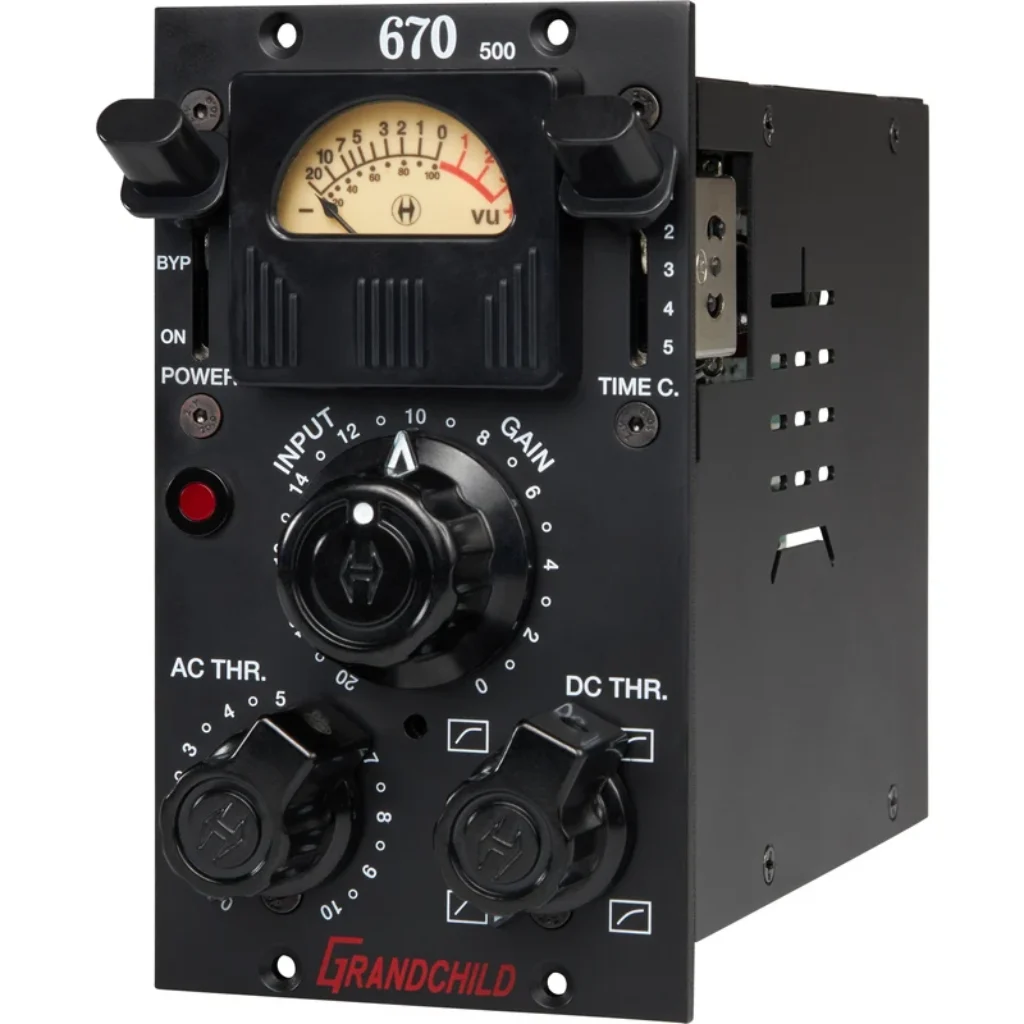
Moving from EQ sculpting into dynamics processing, we encounter what’s possibly Heritage Audio’s most ambitious 500-series module: the Grandchild 670, the world’s first 2-slot stereo Vari-MU tube compressor built for the 500 format.
Inspired by the legendary Fairchild 670’s vintage design, this module delivers authentic tube compression through an all-tube signal path that radiates unmistakable audio warmth and dynamic control.
- 4 NOS 6BA6 (5749) vacuum tubes and 3 custom transformers form the core signal path, ensuring genuine Vari-MU gain reduction behavior.
- 5 selectable Attack/Release time constants replicate the Fairchild’s iconic preset curves.
- Progressive DC Threshold control simultaneously blends ratio and knee characteristics.
- High-pass sidechain filter settings prevent low-frequency pumping during bus compression.
- Stereo 2-slot footprint maximizes chassis real estate efficiency.
You Can Buy This Unit On The Links Below:
Heritage Audio Chassis
Since we covered the 500 series modules from Heritage Audio, now we are going to showcase the chassis that they produce since they are a crucial part for every 500 series lover.
In their small but complete array of chassis, you will be able to find 4, 6, 8 and 10 slot models which is more than enough to pick from. Lets see what they have to offer:
Heritage Audio OST-4 V2
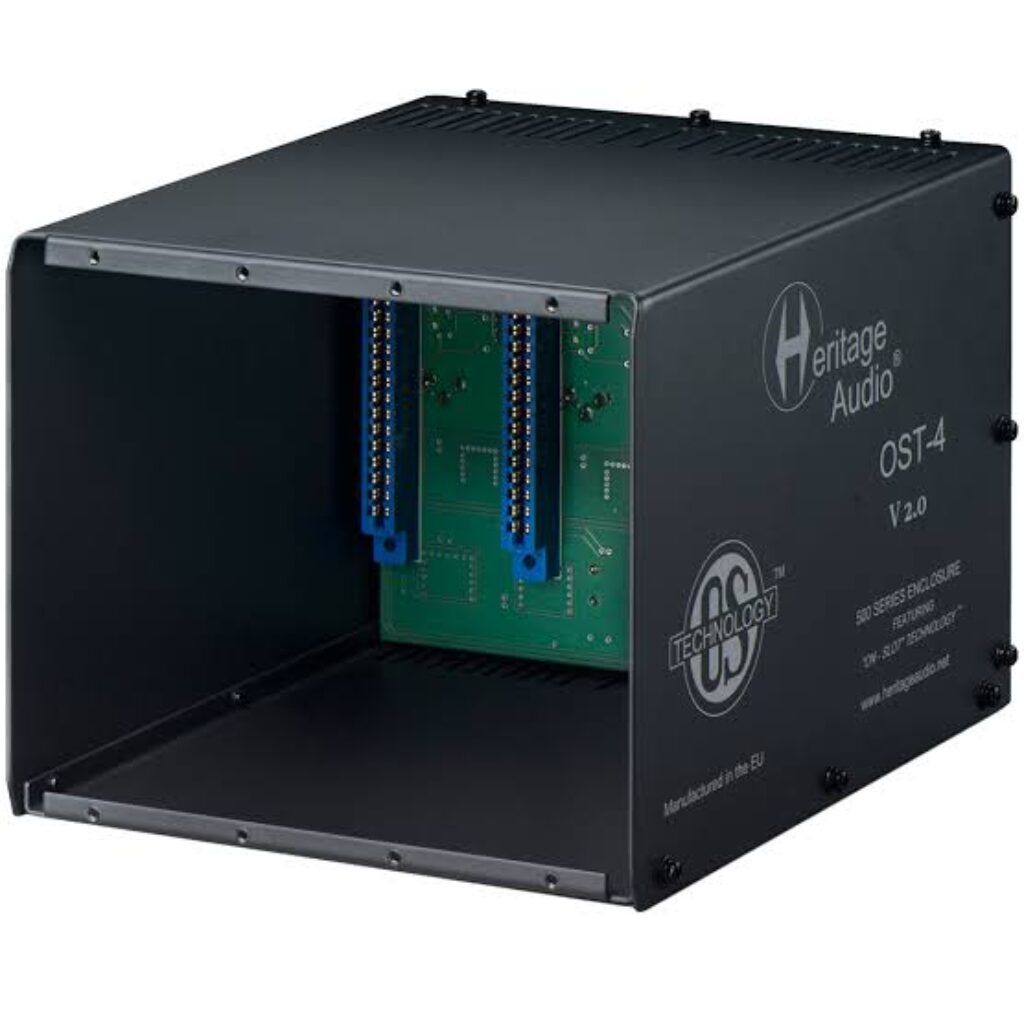
At the foundation of any serious 500-series setup sits the chassis, and the OST-4 V2 delivers Heritage Audio’s proprietary On Slot Technology in a compact, road-ready 4-slot format. Each slot receives independently regulated, filtered power at 400mA per rail, guaranteeing complete audio isolation, even when running power-hungry Class-A or tube modules.
This power regulation eliminates cross-talk, ground hum, and rail sag entirely.
Chassis durability comes from rugged aluminum construction built for studio and stage alike. Gold-plated rear-panel XLR I/O ensures pristine signal integrity, while internal channel link buttons provide slot flexibility by routing audio sequentially between modules without external patch cables, maximizing user convenience.
Clean design aesthetics keep the front panel uncluttered, letting you focus on building signal chains that push boundaries rather than troubleshooting infrastructure.
You Can Buy This Unit On The Links Below:
Heritage Audio OST-6 V2
The OST-6 V2 expands Heritage Audio’s On Slot Technology platform to six independently regulated slots in a versatile 3U rackmountable chassis that ships with detachable rack ears for seamless desktop operation.
This power distribution architecture delivers up to 400mA per rail per slot, guaranteeing module compatibility with demanding Class-A and vacuum-tube units without cross-slot interference.
- Rackmount advantages: 3U form factor with included detachable ears enables studio rack integration or desktop versatility
- Independent OST regulation: Isolates each slot’s power, preventing rail sag from power-hungry modules
- Front-panel LED monitoring: Per-slot power rail indicators provide real-time troubleshooting features for diagnosing module draw
- Rear-panel XLR I/O: Dedicated balanced connections per channel guarantee signal integrity
- Channel link switches: Enable stereo pairing, maximizing 500 series benefits across adjacent slots

You Can Buy This Unit On The Links Below:
Heritage Audio OST-8 ADAT
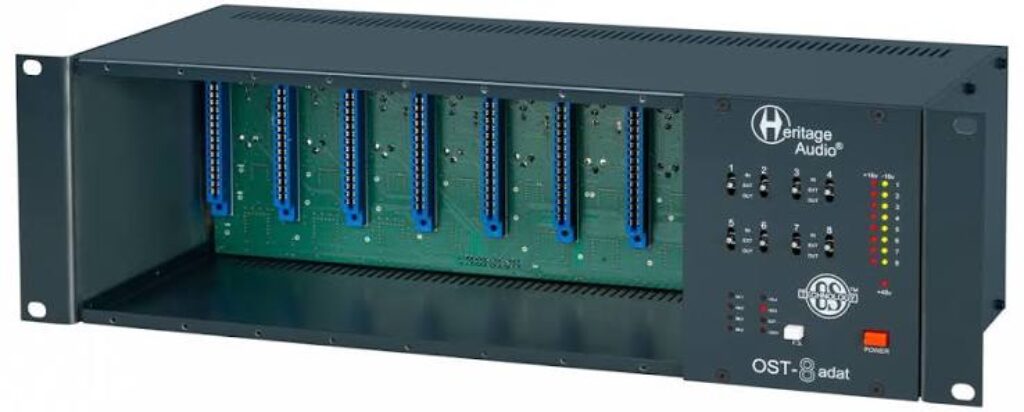
Heritage Audio’s OST-8 ADAT pushes the On Slot Technology platform further by embedding a full 8-channel 24-bit/192 kHz A/D converter directly into an 8-slot 500-series chassis, eliminating the need for external conversion hardware when expanding channel counts.
ADAT optical outputs deliver pristine digital conversion straight to your DAW interface, while BNC Word Clock sync guarantees sample-accurate clocking across your entire signal chain.
Per-channel signal routing switches give you serious audio flexibility, select whether each A/D channel receives audio from the 500-series module output, the rear panel input, or an external analog source.
DB25 TASCAM-pinout and XLR multi pin connectivity handle all analog I/O.
Meanwhile, OST power regulation independently filters and protects each slot, assuring tube-driven or Class-A modules won’t compromise ADAT integration performance through rail sag or crosstalk.
You Can Buy This Unit On The Links Below:
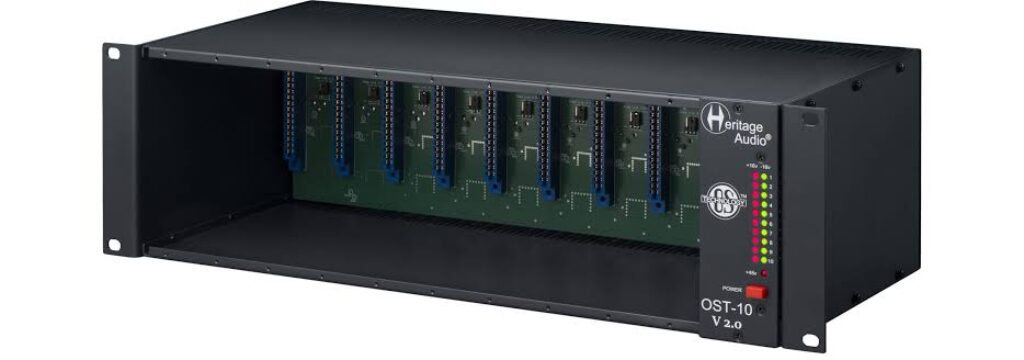
Heritage Audio OST-10 V2
Scaling up to a full 10-slot 3U rackmount configuration, the OST-10 V2 delivers Heritage Audio’s OST at its most expansive, independently regulating, filtering, and protecting each slot with up to 400mA per rail (±16V and +48V), supporting up to 2.0A total non-continuous draw across all ten positions.
- Power supply: Heavy-duty internal PSU guarantees module compatibility with Class-A and vacuum tube units without rail sag or cross-talk.
- I/O options: Rear-panel DB25 and XLR connections provide flexible routing for diverse studio workflows.
- Channel linking: Dedicated front-panel buttons enable stereo pairing across adjacent slots.
- Rail monitoring: Front-panel status LEDs deliver real-time +16V, -16V, and +48V diagnostics at a glance.
- Rackmount features: Aluminum front panel and 3U form factor maximize durability and rack density.
You Can Buy This Unit On The Links Below:
Frequently Asked Questions
Q: Can Heritage Audio 500-Series Modules Work in Non-Heritage Chassis From Other Manufacturers?
A: Yes, the modules maintain full VPR Alliance module compatibility in any standard chassis design, though brand integration varies, you’ll notice performance differences without the OST power isolation. For ideal user experiences, follow proper installation tips regarding power draw.
Q: How Does OST Technology Prevent Cross-Talk Between Tube and Solid-State Modules?
A: The OST architecture delivers solid state isolation by independently regulating each slot’s power rails, ensuring cross talk prevention between tube design and transistor-based modules. This preserves signal integrity, audio fidelity, and seamless module compatibility.
Q: What Maintenance Do the Grandchild 670’s NOS Vacuum Tubes Require Over Time?
A: For performance optimization, we recommend monitoring tube longevity by tracking gain/bias drift annually. Key maintenance tips: store spares under controlled storage conditions, preserving sound quality. The replacement process involves matched-pair NOS 6BA6 swaps for consistent Vari-MU behavior.
Q: Does the OST-8 ADAT Require Special Drivers for Major DAW Compatibility?
A: The OST-8 ADAT is engineered to eliminate ADAT compatibility issues and driver installation process headaches, it’s class-compliant across major DAW support platforms. You’ll experience minimal latency considerations with zero audio quality impact, matching user experiences confirming seamless integration.
Q: Can Heritage Audio Modules Be Used for Live Sound or Only Studio Recording?
A: The modules deliver jaw-dropping module versatility across both live sound and studio recording applications. You’ll maintain pristine sound quality and signal integrity in any environment, while equipment compatibility with standard 500-series chassis guarantees seamless integration.
Conclusion
We’ve walked through Heritage Audio’s 500 series lineup, and ironically, the hardest part isn’t finding a module that delivers, it’s narrowing down which ones not to rack up. From the LANG 312L’s transformer-coupled signal path to the Grandchild 670’s variable-mu compression topology, these aren’t just “budget alternatives.”
They’re spec-for-spec contenders wielding Class-A discrete circuitry and authentic harmonic saturation. Sometimes the “clone” outperforms the “original”, funny how that works.
Related Articles
- Rupert Neve 542 Review: Legacy Tape Emulator!
- Elysia xfilter 500 Review: Pro Audio Stereo Equalizer!
- Chandler tg2 500 Review: 500 Series Microphone Preamp!
- SSL G Bus Review: Great 500 Series Compressor Module!
- Radial Workhorse Cube Review: Amazing 500 Series Chassis!
- Pultec EQP-500X Review: Huge 500 Series Program Equalizer!
- SSL Six 500 Series Review: Big Channel Strip in 500!
- Rupert Neve Designs 511 Review: Amazing Mic-Pre!