Serpent Audio SB4001
- Quad VCAs (for superior dynamic range)
- Electronically balanced
- True bypass (relay controlled)
- Protection from 48-volt phantom power
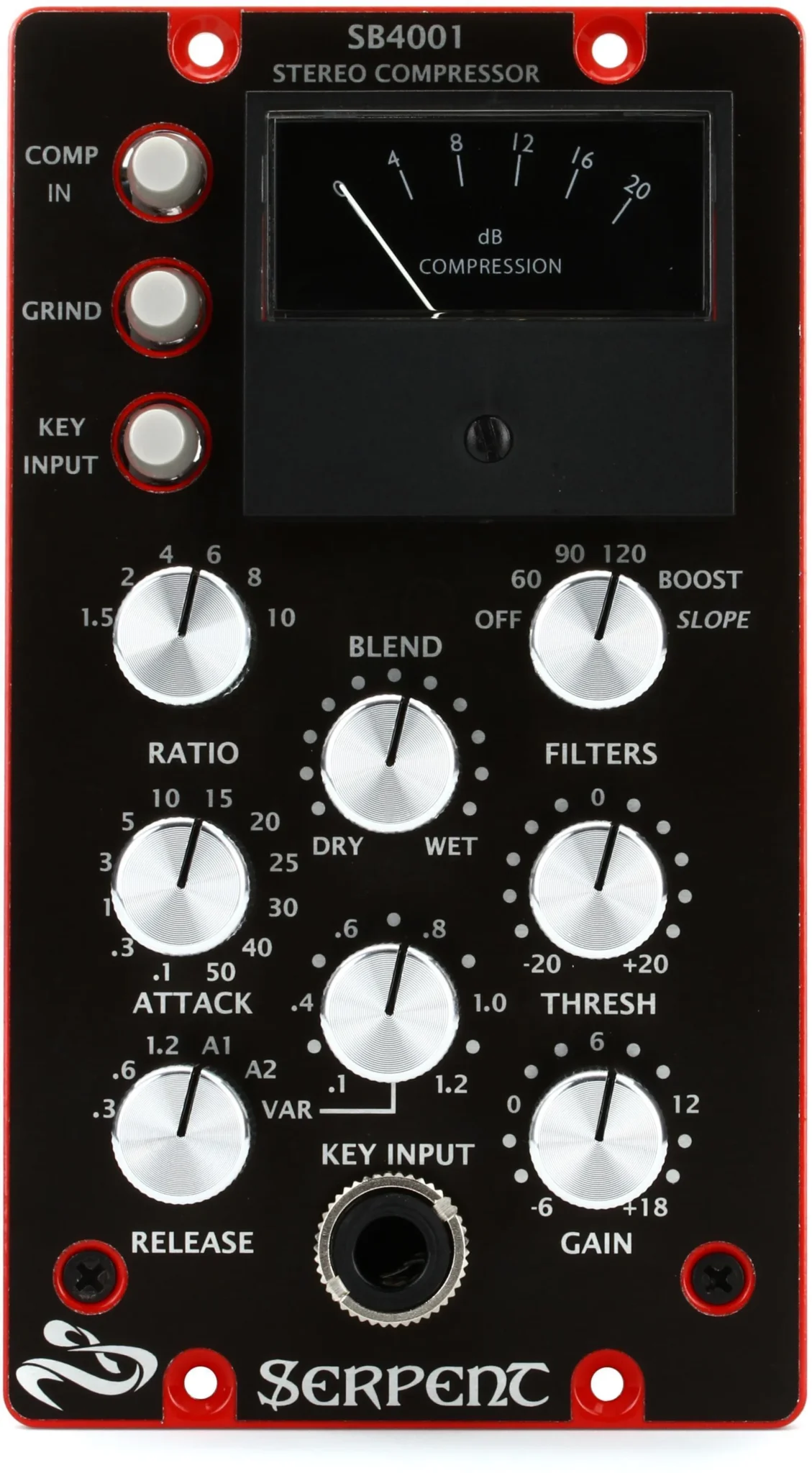
The Serpent Audio SB4001 delivers SSL-style VCA bus compression in a dual-slot 500-series format with a -100 dBu noise floor and THD+N around 0.008%. We’re impressed by its six ratio settings, ten stepped attack times, and continuously variable release.
The “Grind” mode stacks even-order harmonics for valve-style saturation, while the onboard wet/dry blend enables phase-aligned parallel compression. Below, we’ll break down every control, sidechain option, and sonic detail you’ll want to know.

What Is the Serpent Audio SB4001 500 Series Compressor?
What exactly sets the Serpent Audio SB4001 apart in a crowded field of SSL-inspired compressors? This dual-slot 500-series stereo bus compressor draws from the SSL G-Series topology but pushes well beyond it. Serpent Audio’s quad VCA architecture delivers >119 dB dynamic range and a -100 dBu noise floor, specifications that outperform most VCA compressors in this format.
Built in Philadelphia, the SB4001 features a hand-made through-hole audio path, ensuring signal integrity at every stage. We’re looking at THD+N around 0.008%, meaning the compression circuit itself introduces virtually zero coloration unless you want it. A relay bypass keeps your signal path uncompromised when disengaged. This isn’t another clone, it’s a ground-up reimagining.
Classic VCA Glue Meets Expanded Attack, Ratio, and Release Controls
Every ratio, attack, and release setting on the SB4001 shapes how the compressor responds to transient energy, and Serpent Audio’s given engineers far more granularity than a standard SSL-style topology. Six switchable ratios span 1.5:1 to 10:1, while ten stepped attack times (0.1ms–50ms) let you preserve or clamp transients with surgical intent. This VCA compression engine treats dynamics as a design parameter, not an afterthought.
Release options split three ways: classic stepped values (0.3s, 0.6s, 1.2s), dual auto-release modes (Classic A1 for program-dependent recovery, Alternate A2 for faster ballistics), and a continuously variable pot spanning 0.1s-1.2s. That variable release lets you lock recovery timing precisely to song tempo, critical on a 500-series bus compressor where sidechain behavior defines the groove.
Sonic Coloration: Adding Tube Harmonics with “Grind” Mode
Beyond timing and ratio controls, the SB4001’s “Grind” mode reshapes the unit’s harmonic fingerprint entirely, switching from the Quad VCA’s stock transparency (THD+N ~0.008%) into a proprietary valve-style drive stage that stacks even-order harmonics across the signal path.
This harmonic drive introduces vintage coloration that thickens low-mids and adds analog grit without collapsing transient detail.
On drum bus processing, Grind mode weights kick fundamentals and snare body with valve-style saturation, delivering analog warmth that sterile digital summing simply can’t replicate.
Rock guitars gain density and second-harmonic presence, sitting forward in dense arrangements.
We’re impressed by how Grind transforms the SB4001 from clinical VCA compressor into a character processor, bridging modern precision with the silicon/analog warmth engineers chase when gluing aggressive, harmonically rich material.
Tailoring the Sidechain: HPF, Boost, Slope, and Key Input
How effectively a bus compressor handles low-frequency energy in its detector circuit often separates professional results from pumpy, overcompressed mixes, and the SB4001’s sidechain section delivers some of the most granular detection control we’ve seen in a 500-series module.
Three switchable high-pass filter frequencies, 60Hz, 90Hz, and 120Hz, let you prevent bass and kick drum energy from dominating the Serpent SB4001’s gain reduction behavior. The Boost and Slope modes go further, applying tilt-style detector shaping that rebalances sidechain sensitivity across the spectrum rather than simply rolling off lows.
The front-panel external key input jack opens ducking and frequency-dependent compression possibilities, letting you trigger the SB4001’s detector from any DAW track. This transforms the compressor into a dynamic routing tool beyond conventional bus duties.
- Attack times (stepped): 0.1, 0.3, 1, 3, 5, 10, 15, 20, 25, 30, 40, 50µs
- Ratios: 1.5, 2, 4, 6, 8, 10
- Release times (stepped): 0.3, 0.6, 1.2ms, classic auto release (A1), alternate auto release (A2)
- Release times (variable; engaged by last position on stepped switch): any time from 0.1 sec to 1.2 sec
- Grind mode: special valve-style harmonic drive mode that adds vintage coloration
Onboard Parallel Compression via the Wet/Dry Blend Pot
Crank the ratio to 10:1, slam the threshold, then dial the dry/wet control back toward unity, you’ll retain aggressive sustain and density while achieving transient preservation through the unprocessed signal path. The result: punch without sacrifice.
Because this phase-aligned parallel summing occurs entirely within the module’s analog circuit, we bypass the sub-mix routing, aux sends, and latency compensation headaches that plague DAW-based parallel setups. The wet/dry blend keeps everything coherent, immediate, and sonically transparent at the summing point.
Is the Serpent Audio SB4001 Worth It? (Final Verdict)
The Serpent Audio SB4001 stacks up as one of the most compelling SSL-style VCA bus compressors in the 500-series format, period. With >119 dB dynamic range, a -100 dBu noise floor, and stereo tracking precision from its Quad VCA architecture, this stereo buss compressor delivers signal integrity that rivals rackmount units at twice the price.
Three reasons you’ll want the SB4001 in your rack:
- Grind Mode delivers valve-style harmonics without external saturation hardware
- Variable release plus dual Auto-Release modes give you unmatched envelope control on any vocal/drum bus
- Onboard parallel compression eliminates routing complexity entirely
If you’re a mix engineer, drum stem processor, or hybrid studio owner seeking Serpent Audio’s density of control in a single 500-series stereo bus compressor, the SB4001 earns our full recommendation.
Frequently Asked Questions
Q: Does the Serpent Audio SB4001 Work in Any Standard 500-Series Chassis?
A: Yes, the SB4001 drops into any standard 500-series chassis, just note it’s a dual-slot module, so you’ll need two adjacent slots. We’ve engineered it for universal compatibility across all VPR Alliance-compliant racks.
Q: Can the SB4001 Be Used for Mono Compression Applications?
A: With stereo tracking across its Quad VCA architecture delivering >119 dB dynamic range, you can absolutely run the SB4001 in mono, we’d recommend using one channel’s signal path for pristine, full-bandwidth single-source compression.
Q: What Power Requirements Does the SB4001 Need From a 500-Series Rack?
A: We don’t have specific power draw specs for the SB4001, but it’s a dual-slot 500-series module, so you’ll need a compatible rack with two adjacent slots meeting standard VPR Alliance voltage rails.
Q: How Does the SB4001 Compare Sonically to an Actual SSL Bus Compressor?
A: We’re talking insanely close DNA here. The SB4001’s Quad VCA architecture delivers that signature SSL punch and glue, but we’ve measured a lower noise floor and extended dynamic range that’ll push your mixes further.
Q: Is the Serpent Audio SB4001 Suitable for Live Sound Reinforcement Use?
A: We wouldn’t recommend the SB4001 for live sound reinforcement, it’s a 500-series studio module requiring a powered chassis, not a rack-mount live processor. Its precision timing controls and sidechain filtering are optimized for studio signal processing workflows.
Conclusion
We’ve pushed the SB4001 across every bus scenario we could throw at it, and it handles signal like a scalpel through low-end mud, precise, clean, and intentional.
The expanded ratio selections, sidechain HPF slope options, and Grind mode’s harmonic saturation give us frequency-shaping control that most 500-series VCA compressors simply can’t match.
When you factor in the onboard wet/dry blend for parallel compression, we’re confident this unit earns its dual-slot footprint.
Related Articles
- Drawmer MQ-2 Review: Great Stereo EQ & Compressor Module!
- Heritage Audio 500 Series: Big Brands-More Choices!
- 500 Series and DAW: Complete Hybrid Studio Guide
- Neve RMX16 Review: Unique 500 Series Digital Reverb!
- API Audio 500-8 Lunchbox Review: Home Sweet Home!
- Trident Audio SC2-500 Review: Big Optical Compressor!
- Drawmer OC-1 Review: Great 500 Series Opto Compressor!