Neve RMX16 Review
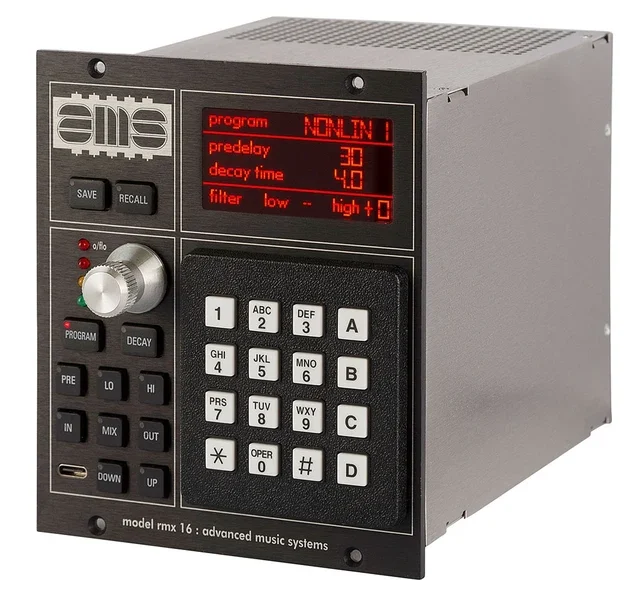
- 18 Different reverb programmes
- 100 user presets
- 2.4″ OLED display
We’ve spent extensive hands-on time with the AMS Neve RMX16 500-series module, and it faithfully captures the iconic reverb character that shaped records from Peter Gabriel’s So to Phil Collins’ Face Value.
Its 32-bit DSP engine runs all 18 algorithms, including the legendary Non-Lin 2 gated snare, through 24-bit/48kHz converters delivering over 100dB of dynamic range. The added Wet/Dry blend and 100 user presets modernize the workflow considerably. Below, we’ll break down every algorithm, control, and routing detail you need.

Introduction & Historical Significance of the AMS Neve RMX16
The AMS Neve RMX16 500-Series Digital Reverb isn’t just another reissue, it’s a faithful hardware recreation of the world’s first microprocessor-controlled, full-bandwidth digital reverberator, originally released in 1982 as a massive 2U rackmount unit packed with dense circuit boards.
AMS Neve compressed all that processing power into a 3-slot 500 series module running bit-for-bit identical algorithms on a modern 32-bit DSP engine.
The historical significance of the AMS RMX16 digital reverb can’t be overstated. Its textures defined seminal records by Phil Collins, Peter Gabriel, and Kate Bush, embedding its gated snare and lush hall programs into the sonic DNA of an entire decade.
For engineers seeking that unmistakable character in a compact, rack-ready format, this microprocessor-controlled classic delivers without compromise.
Hardware Architecture, DSP Engine, and 500-Series Slot Requirements
Beneath its compact faceplate, the RMX16 500 packs a high-performance 32-bit DSP engine that runs bit-for-bit recreations of every original algorithm through 24-bit/48kHz AD/DA converters, delivering over 100dB of dynamic range and +22dBu of analog headroom.
This DSP processing architecture accurately models the analog I/O stages of the original unit while leveraging modern conversion technology.
The rmx16 500 series module spans three slots, with a specific I/O routing topology: mono input and left output connect through Slot 1, while the right output routes through Slot 3, leaving Slot 2’s connections unused.
Power draw sits at approximately 200 mA total across the +/-16V rails, ensuring cool operation and full compliance with standard VPR chassis supplies in the 500 series format.
Deep Dive into the 18 Classic Reverb & Delay Algorithms
Eighteen algorithms form the RMX16 500’s complete sonic arsenal, nine original factory programs and nine expansion programs that were once accessible only through the notoriously rare barcode wand accessory.
The factory set delivers iconic digital reverberation through Ambience, Room A1, Hall C1, Plate A1, Hall B3, Chorus, Echo, Non-Lin 2, and Reverse 1. Non-Lin 2 remains the definitive gated snare reverb algorithm, its sharp envelope cutoff defined an entire era of drum production.
The expansion presets, Delay, Freeze, Hall A1, Non-Lin 1, Image P1, Plate B1, Reverse 2, Room A0, and Room B1 unlock deeper sound design territory. Freeze captures and sustains audio indefinitely, while Image P1 generates spatial depth impossible with conventional rmx16 reverb processing.
- Iconic 1980s digital reverb unit in 500-series format module
- Includes 9 original programs and 9 custom programs
- Tweakable parameters include decay time, pre-delay, decay filter, and wet/dry mix
- 100 user slots for storing your favorite custom programs
- 3-slot-wide 500-series module
Front Panel Controls, Keypad Interface, and OLED Display Navigation
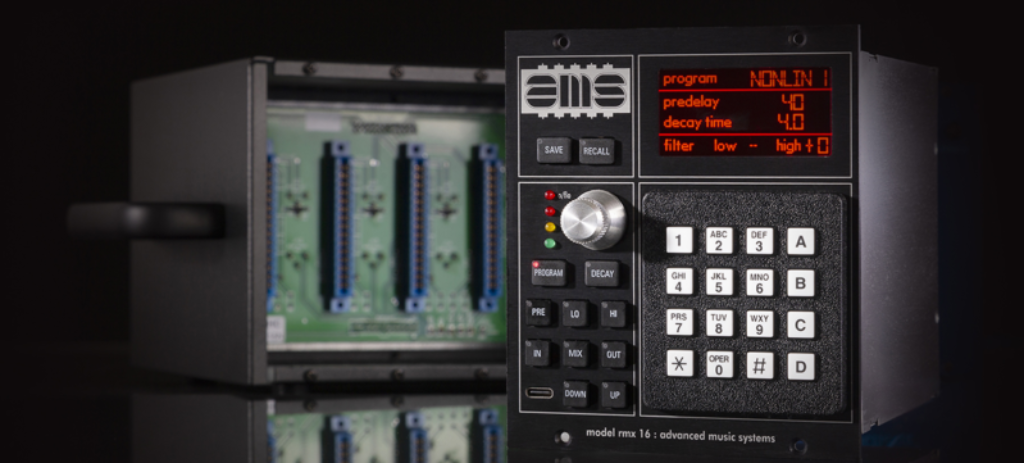
AMS Neve’s front panel layout puts every critical parameter within immediate reach through a calculator-style alphanumeric keypad, endless push rotary encoder, dedicated nudge keys, and traffic-light LED input metering, all centered around a high-contrast monochromatic OLED display that’s a massive visibility upgrade over the original unit’s dim LED readout.
The keypad lets us punch in exact numerical values for decay time, pre-delay, and EQ filtering directly, no menu diving required. Nudge keys provide fine-grained parameter adjustments in precise increments, while the push encoder handles broader sweeps and program selection.
The traffic-light LEDs deliver instant gain staging confirmation at a glance. This RMX16 500 digital reverberator preserves the original’s tactile workflow philosophy while the OLED guarantees readability in any lighting condition.
Modern Workflow Upgrades: Wet/Dry Blend & User Preset Recall
While the original 1982 RMX16 lived exclusively on auxiliary send/return buses, the 500 series edition adds a dedicated Wet/Dry mix blend control that fundamentally expands its routing flexibility. You can now patch this 500 series module directly across a channel insert during tracking, dialing in precise wet/dry blend ratios without requiring a separate bus.
| Feature | Original RMX16 | 500 Series Edition |
|---|---|---|
| Wet/Dry Blend | Not available | Dedicated control (0-100%) |
| User Preset Storage | None | 100 memory slots |
| Input and Output Levels | Fixed | Digitally controlled |
The 100 user preset slots let you save and recall customized reverb parameters across sessions, eliminating the need to rebuild settings from scratch. Each preset stores complete algorithm configurations instantly.
Final Verdict: Value, Pros & Cons, and Studio Recommendation
Beyond workflow improvements, the RMX16 500’s core value proposition rests on delivering authentic, bit-for-bit recreations of all 18 original and expansion algorithms through a modern 32-bit DSP engine, and it delivers convincingly.
- Pros: All 18 original algorithms included, Wet/Dry blend for insert use, 100 user presets, premium construction with Neve build quality
- Cons: Occupies 3 chassis slots, mono-in/stereo-out only, premium price tag limits budget-conscious buyers
- Best for: Mixing engineers seeking hardware-driven vintage digital reverb character
- Skip if: You need stereo input processing or compact single-slot solutions
We’d recommend the Neve RMX16 500 without hesitation for studios prioritizing iconic reverb tones.
No plugin truly replicates the experience of dialing in hardware, this unit proves it.
Frequently Asked Questions
Q: Can the RMX16 500 Be Used in a Single-Slot or Dual-Slot Chassis?
A: No, you can’t use the RMX16 500 in a single or dual-slot chassis. It requires three consecutive 500 series slots, utilizing Slot 1 for mono input/left output and Slot 3 for right output.
Q: Does the RMX16 500 Support Stereo Input or Only Mono Input?
A: The RMX16 500 accepts mono input only via Slot 1. However, it delivers stereo output. Left through Slot 1 and Right through Slot 3, giving you full stereo reverb processing from a single mono source.
Q: Is Firmware Updatable via USB or Any External Connection?
A: The available specifications don’t detail a USB port or external firmware update mechanism. We’d recommend contacting AMS Neve directly, as they’ll confirm whether the RMX16 500’s DSP firmware supports field-upgradable connectivity.
Q: Can Presets Be Transferred Between Multiple RMX16 500 Units?
A: Unfortunately, we haven’t found any documented preset transfer capability between multiple RMX16 500 units. There’s no USB, MIDI, or SysEx connectivity specified for inter-unit preset sharing or backup.
Conclusion
We can’t overstate how effectively AMS Neve has distilled four decades of reverb heritage into three rack slots. The 32-bit DSP faithfully executes all 18 original algorithms, the OLED interface streamlines preset recall, and the wet/dry blend adds essential modern functionality.
Is it an investment? Absolutely, but what’s the cost of settling for emulations that merely approximate the real thing? For studios demanding authentic RMX16 character, this module delivers definitively.
Related Articles
- Rupert Neve 542 Review: Legacy Tape Emulator!
- Elysia xfilter 500 Review: Pro Audio Stereo Equalizer!
- Chandler tg2 500 Review: 500 Series Microphone Preamp!
- SSL G Bus Review: Great 500 Series Compressor Module!
- Radial Workhorse Cube Review: Amazing 500 Series Chassis!
- Pultec EQP-500X Review: Huge 500 Series Program Equalizer!
- SSL Six 500 Series Review: Big Channel Strip in 500!
- Rupert Neve Designs 511 Review: Amazing Mic-Pre!