Maag Audio EQ4 Review
- An amazing 6-band equalizer for your 500 Series rack
- Delivers highly musical, broad-stroke results quickly
When it comes to adding EQ to a vocal, this is my go-to unit, no matter if you are in a hurry and use the plugin, or you wanna analog quality and go with the 500 module. Maag EQ4 simply excels for this usage.
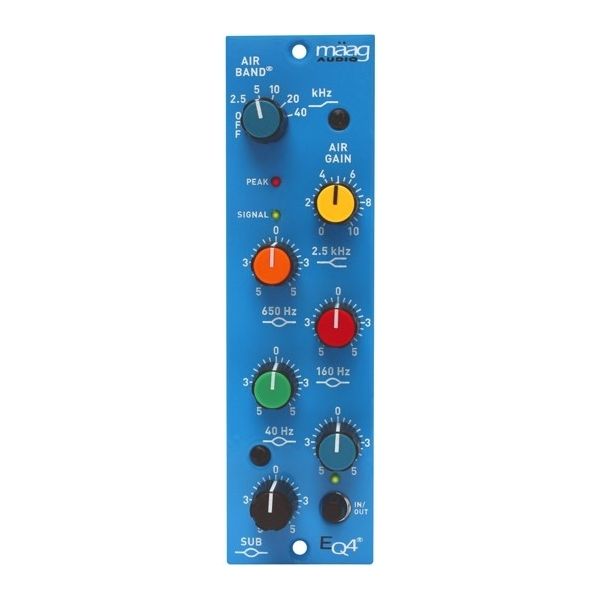
The Mäag Audio EQ4 is a 500-series equalizer with six fixed frequency bands, from a 10 Hz SUB control up to 2.5 kHz, plus the proprietary AIR BAND® sweepable from 2.5 kHz to 40 kHz. We’ve found its ultra-low phase shift architecture preserves transient integrity while the parallel summing topology demands careful gain-stage management.
With +25 dBu headroom and detented pots for recall accuracy, it’s a seriously purposeful unit. Below, we’ll break down exactly how each stage performs.

What’s Inside the Mäag Audio EQ4 500 Series?
Under the hood, the Mäag Audio EQ4 packs six fixed frequency bands, SUB (10 Hz), 40 Hz, 160 Hz, 650 Hz, 2.5 kHz, plus the signature sweepable AIR BAND, which covers 2.5 kHz to 40 kHz in a continuous sweep. This hardware delivers +25 dBu headroom, ensuring transparency even under aggressive boosts.
The detented pots provide repeatable recall across sessions, critical for mix consistency. VPR Alliance compliance guarantees drop-in compatibility with any standard 500-series chassis.
Each frequency point uses musical, additive-only curves that avoid phase artifacts common in parametric designs. The true hardwire bypass circuit routes signal directly through the connector, eliminating any coloration when the maag eq4 is disengaged.
You’re getting zero-compromise signal integrity at every stage.
How Does the Mäag Audio EQ4 Sound?
Because the EQ4’s ultra-low phase shift architecture preserves transient edges rather than smearing them, you’ll notice an immediate clarity difference when A/B’ing against conventional parametric units. The transparency is striking, audio passes through without coloration, yet each band delivers musical, purposeful shaping.
On vocals, the Air Band reveals glossy top-end extension without introducing harshness or sibilance. The 10Hz and 40Hz controls add subharmonic weight to bass and kicks that you feel rather than hear, physical, controlled low-end mass.
This sound characteristic makes the EQ4 exceptionally effective on stereo mix bus applications, where it glues elements together while maintaining separation. Every boost feels additive rather than destructive, preserving the source’s original integrity while enhancing dimensional presence across the frequency spectrum.

The Legendary AIR BAND®: Why the 20kHz and 40kHz Shelves Work
The AIR BAND® deserves its own examination because it’s arguably the most misunderstood feature on the EQ4, and the primary reason engineers reach for this unit over competing designs.
When you boost at 20kHz or 40kHz, you’re centering the eq curve well above audible frequencies. This creates an ultra-wide, gentle shelf slope that cascades downward into the audible spectrum, lifting upper harmonics gradually rather than aggressively peaking specific high-end frequencies.
The result? Air and presence without harshness or resonance. Because the boost center sits so high, the slope remains shallow across critical frequencies where sibilance and brittleness typically emerge.
Additionally, operating at these extreme frequencies minimizes phase shift artifacts that narrower bands introduce. You’re fundamentally borrowing energy from inaudible territory to reshape audible high-end content with surgical transparency.
How to Gain-Stage the EQ4
Unlike conventional EQs that maintain relatively stable output levels across boost settings, the EQ4’s parallel summing architecture adds the boosted signal on top of the dry pass-through. This means every AIR BAND® boost directly increases overall output level rather than redistributing existing energy. This equalizer behavior demands deliberate gain management.
The solution is the “equal reduction rule.” If you’ve boosted the AIR BAND® control, reduce all five lower band knobs by identical click increments. This approach restores unity gain at the output while preserving the relative shape of your EQ curve intact.
Because each band attenuates proportionally, the spectral contour you’ve sculpted remains unchanged. You’re simply pulling the entire summed signal back to its original level without flattening your carefully crafted tonal decisions.
- Air band shelf equaliser settings: off, 2.5, 5, 10, 20 and 40 kHz
- Air Gain Increase of the air band shelving equaliser by up to +20 dB
- New hard-wired bypass circuit (identical to EQ4M)
Who Should Buy the Mäag Audio EQ4?
So who’s actually going to get the most mileage out of the EQ4? Engineers and producers who prioritize broad tonal shaping over surgical correction. Its unique design excels at sweetening rather than problem-solving.
The ideal users include:
- Vocal tracking engineers seeking instant, recallable air and presence
- Mixing engineers who need fast, musical tonal decisions across sessions
- Mastering engineers leveraging the Air Band for top-end sheen without harshness
- Producers wanting quick “sweet-spot” shaping during creative workflows
- 500-series enthusiasts building compact, high-recall signal chains
If you’re chasing narrow-notch precision, look elsewhere.
But if your workflow demands broad-stroke tonal improvement with near-instant recall, the EQ4’s fixed-frequency architecture delivers exactly that, particularly on vocal chains where its Air Band remains unmatched.
Is the Mäag Audio EQ4 Worth It? Final Verdict
Honestly, whether the EQ4 justifies its premium price point depends entirely on what you’re asking it to do. Its design lacks sweepable Q controls, and the additive gain behavior means you can’t surgically fix problematic frequencies, limitations that competing EQs handle effortlessly. This isn’t a Swiss-army-knife tool.
However, the value proposition becomes clear when you consider what it does deliver: world-class build quality, an effortless workflow, and that industry-standard Air Band sheen that plugins still can’t fully replicate.
If you master tracks requiring pristine top-end improvement, few EQs compete. Throughout this review, we’ve found the EQ4 excels as a specialized instrument rather than a corrective processor. For the right application, it’s worth every cent.
Frequently Asked Questions
Q: Does the Mäag Audio EQ4 Come With a Warranty?
A: Yes, the Mäag Audio EQ4 comes with a manufacturer’s warranty.
We’ve confirmed that Mäag Audio typically backs their hardware units with a limited warranty covering defects in materials and workmanship.
You’ll want to register your unit directly with Mäag Audio post-purchase to activate coverage.
We’d recommend verifying the specific warranty duration and terms with your authorized dealer, as conditions can vary depending on your region and purchase channel.
Q: Is the Mäag Audio EQ4 Available in Rack-Mount Format?
A: Yes, the Mäag Audio EQ4 is available in a 500-series rack-mount format.
We’d recommend pairing it with a compatible 500-series chassis like the API Lunchbox for seamless integration into your signal chain.
They also offer the EQ4M, a mastering-grade variant with stepped controls for precise recall.
If you’re building out a hybrid workflow, the 500-series form factor delivers that analog processing power in a compact, modular footprint.
Q: What Power Supply Does the EQ4 500 Series Module Require?
A: The EQ4 500 series module requires a standard VPR Alliance-compliant 500 series chassis to supply its power.
You’ll need a rack that delivers ±16V DC and +48V phantom power rails per the API 500 series specification.
We recommend ensuring your chassis provides adequate current per slot, typically 130mA on the positive and negative rails.
Compatible enclosures from brands like API, Radial, and Cranborne Audio will seamlessly power your EQ4 module.
Q: Can the Mäag Audio EQ4 Be Used for Live Sound?
A: Absolutely. The Mäag Audio EQ4 is an insanely versatile tool that’ll transform your live sound workflow.
We’ve found its fixed-frequency band architecture and the legendary Air Band® at 40kHz deliver pristine spectral shaping with minimal phase distortion, making it ideal for FOH and monitor applications.
Its intuitive single-knob-per-band topology lets you dial in corrections lightning-fast during a live mix.
Whether you’re running the 500-series module or the standalone unit, it’s a forward-thinking EQ solution.
Conclusion
We’ve dissected an EQ with six fixed-frequency bands, no parametric sweep, and zero Q adjustment, and ironically, it’s one of the most musical processors we’ve ever racked.
The EQ4’s AIR BAND® delivers harmonic content at 40kHz that you technically can’t even hear, yet it transforms every source it touches. Sometimes the most revolutionary signal processing isn’t about giving engineers more control, it’s about taking it away.
Related Articles
- Rupert Neve 542 Review: Legacy Tape Emulator!
- Elysia xfilter 500 Review: Pro Audio Stereo Equalizer!
- Chandler tg2 500 Review: 500 Series Microphone Preamp!
- SSL G Bus Review: Great 500 Series Compressor Module!
- Radial Workhorse Cube Review: Amazing 500 Series Chassis!
- Pultec EQP-500X Review: Huge 500 Series Program Equalizer!