Empirical Labs Pump Review
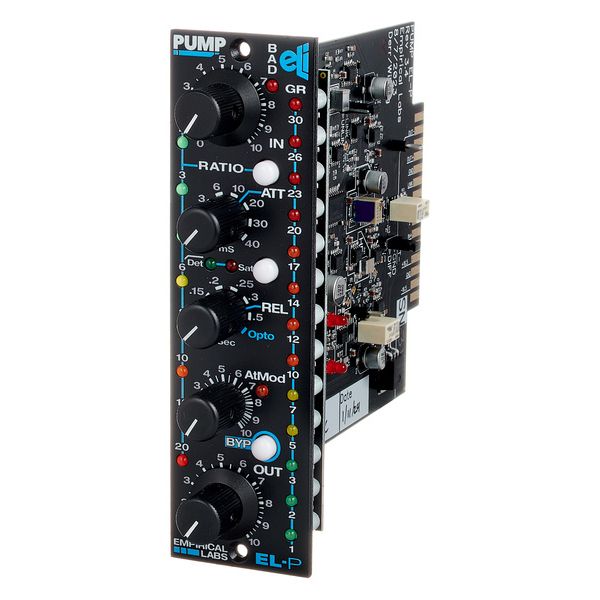
- Adjustable input level with clip LED
- 8 Selectable compression ratios (2:1 to 20:1)
- Adjustable attack time (200us bis 40ms)
So here we have something that probably is looked for in the circles of 500 series fanatics that heard the good words about the Distressor. The developer delivered and created a unit that will be suitable for our 500 series chassis – the Pump!
The Empirical Labs Pump is a single-slot 500 series VCA compressor offering a massive 125dB dynamic range, eight discrete ratios from 2:1 to 20:1, and digitally-stepped pots for total recall accuracy.
We’re impressed by its AtMod control, which reshapes the attack envelope to preserve transients even at aggressive settings. The 70Hz detector HPF and germanium soft clipper add serious tonal flexibility. Below, we’ll break down exactly how each feature performs in practice.

What Is the Empirical Labs Pump 500 Series Compressor?
The Empirical Labs Pump (EL-P) is a single-slot 500 series VCA compressor designed by Dave Derr, drawing its detector topology and gain reduction architecture directly from the Distressor, Mike-E, and Arousor plugin lineage.
This isn’t a stripped-down derivative, it’s a concentrated distillation of ELI’s compression DNA into a lunchbox-ready format.
We’re looking at a 125dB dynamic range with a noise floor hitting -101dBu, which is exceptional for any 500 series compressor.
Power draw sits at approximately 100mA on standard +/-16V rails, keeping it compatible with virtually every powered chassis.
The build quality reflects Empirical Labs’ reputation-stepped controls throughout enable precise recall, and the signal path extends from 5Hz to 175kHz (-3dB).
How Does the Empirical Labs Pump Sound?
How versatile is this compressor across studio sources? The Empirical Labs Pump delivers everything from transparent gain riding at 2:1 to brick-wall limiting at 20:1.
On snare, high ratios with fast attack settings produce aggressive clamping, while the attack modification knob lets initial transients punch through before compression engages, preserving crack and body simultaneously.
Rock vocals benefit from mid-ratio settings where the detector HPF prevents low-frequency pumping, maintaining intelligibility without sacrificing density.
On acoustic guitar, gentle ratios yield invisible level control. Electric bass thrives with the germanium saturation circuit adding harmonic weight.
Each ratio reshapes the knee characteristics, making this 500 series classic knee compressor surprisingly flexible. The 125dB dynamic range guarantees pristine headroom regardless of how aggressively you’re driving the signal path.
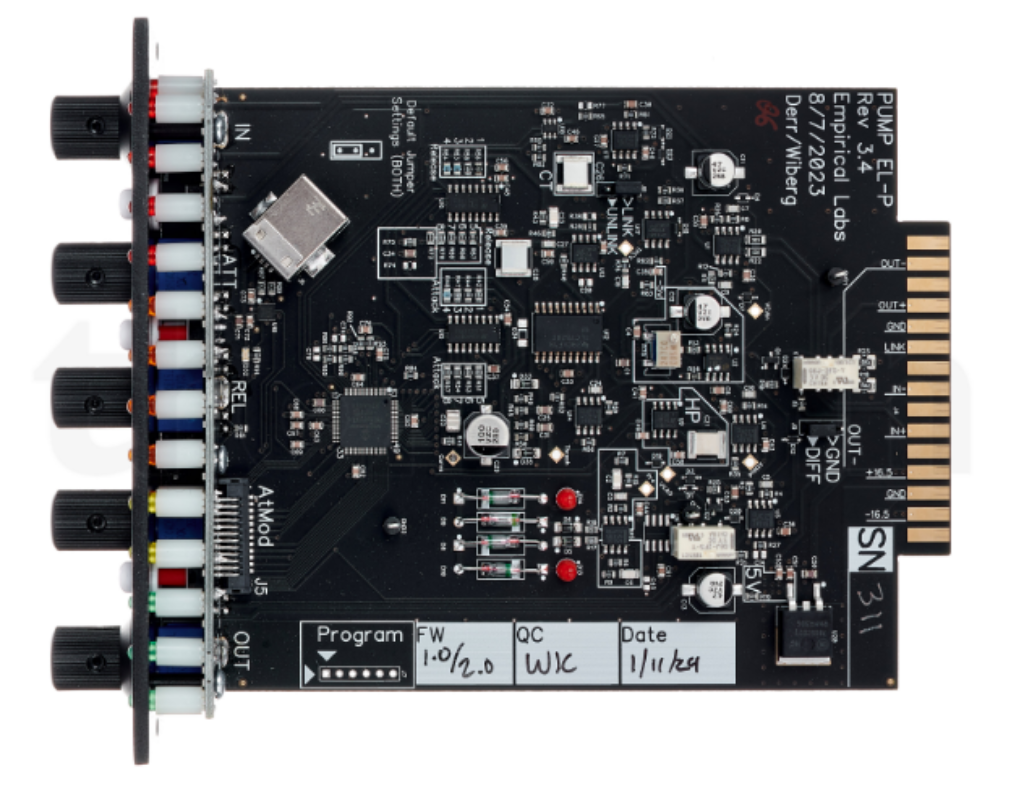
Understanding the 8 Compression Ratios and Stepped Recall
Eight discrete ratio settings (2:1, 3:1, 4:1, 6:1, 8:1, 10:1, 12:1, and 20:1) give the Pump a compression range spanning gentle gain riding to near brick-wall limiting. Each ratio doesn’t just change the slope; it reshapes the knee curve itself.
Combined with the AtMod control, every ratio produces a unique curve influencing transient behavior and gain reduction depth.
- 2:1–4:1: Soft-knee characteristics ideal for transparent bus glue and vocal leveling
- 6:1–8:1: Medium-knee compression delivering assertive dynamic control without crushing transients
- 10:1–12:1: Hard-knee behavior approaching limiting territory for aggressive tracking
- 20:1: Near brick-wall limiting for peak protection
- Digitally-stepped pots for attack and release guarantee precise compressor time constants recall across sessions, eliminating guesswork from your workflow.
The AtMod Advantage: Preserving Transients with Attack Modification
Born in the Arousor plugin and now making its first appearance in Empirical Labs hardware, the Attack Modification (AtMod) control reshapes the initial slope of the compressor’s attack envelope without altering the overall attack time constant.
This compressor module lets you dial in aggressive ratio settings, say 10:1 or 20:1, to crush sustain and room decay while the AtMod preserves the transient’s leading edge.
The initial attack slope softens, allowing pick attacks, snare cracks, and kick thuds to punch through before gain reduction fully engages.
You’re fundamentally decoupling transient impact from sustained compression depth. For engineers chasing heavily compressed drum tones without sacrificing that visceral snap, AtMod eliminates the traditional compromise.
It’s surgical envelope shaping that transforms how aggressively you can push the Empirical Labs Pump without flattening dynamics.
- Adjustable release time (50ms to 500ms) with selectable Opto setting
- Switchable 110Hz sidechain highpas-filter and saturation soft-clipper
- Gain reduction meter with 13 LEDs
- Adjustable Attack Modification changes the attack response and transient processing
- Frequency range: 5Hz – 175kHz
Sidechain HPF and Germanium Soft-Clipping
Two additional circuit-level tools, the switchable 70Hz Detector High-Pass Filter and the Germanium diode soft-clipper extend the Pump’s tonal versatility well beyond standard VCA compression.
- 70Hz high-pass filter: Removes sub-low energy from the detector path, preventing kick drums and bass instruments from over-triggering the VCA and causing unwanted gain reduction pumping.
- Germanium soft clipper: Rounds sharp voltage peaks using Germanium diode topology derived from the Mike-E, injecting warm harmonic saturation without harsh digital-style clipping.
- Tone-shaping utility: Both features operate independently, enabling layered signal conditioning.
- Mix-bus resilience: Engaging the HPF on full-mix duties preserves low-end integrity while compressing midrange and highs aggressively.
- Saturation stacking: Combining the soft clipper with higher ratios yields dense, analog-rich harmonic content ideal for forward-leaning productions.
Who Should Buy the Empirical Labs Pump? (Final Verdict)
Whether you’re a mix engineer chasing Distressor-DNA compression in a single-slot 500 series footprint or a tracking engineer who needs sub-millisecond attack times with AtMod’s transient-shaping finesse, the Empirical Labs Pump earns its rack space decisively.
Every knob is stepped for total recall accuracy, critical for engineers and producers demanding session-to-session consistency. The germanium soft-clipper, opto release mode, and detector HPF deliver versatility that punches well above its price class.
Customer reviews consistently highlight the Pump’s transient control as a differentiator: AtMod’s hardware debut gives you plugin-level envelope sculpting in an analog signal path.
If your 500 series rack needs a compressor that merges Dave Derr’s proven compression topology with modern workflow demands, the EL-P is the definitive buy.
Frequently Asked Questions
Q: What Is the Noise Floor and Dynamic Range of the Empirical Labs Pump?
A: For a module that fits in a single 500 series slot, it’s *almost unfair*, the EL-P delivers a staggeringly low noise floor of -101dBu and a massive 125dB dynamic range.
We’re talking specs that rival full-rack units at a fraction of the footprint.
These numbers mean you’re getting pristine signal integrity with virtually zero self-noise, giving you headroom that’ll handle everything from delicate vocal takes to crushing parallel drum compression.
Q: How Much Current Does the Empirical Labs Pump Draw From 500 Series Racks?
A: The Empirical Labs Pump draws approximately 100mA from standard +/-16V 500 series power rails.
That’s a modest current footprint for a compressor packing this much processing muscle, VCA gain control, an opto-coupler release network, germanium soft-clipping, and a 13-segment LED meter all running within that envelope.
We’d recommend verifying your rack’s per-slot current capacity, but most quality 500 series chassis will handle the Pump without breaking a sweat.
Q: Does the Empirical Labs Pump Offer True Bypass or Buffered Bypass?
A: The EL-P features true hardwire bypass, not a buffered circuit that colors your signal path even when disengaged.
Here’s where it gets interesting: when you bypass the Pump, your audio routes through a direct mechanical connection, completely circumventing all active electronics.
We’re talking zero latency, zero phase shift, zero coloration.
For those of you chasing pristine signal integrity in dense 500 series setups, this isn’t just convenient, it’s architecturally essential.
Q: What Is the Frequency Response Specification of the Empirical Labs Pump?
A: The EL-P delivers a frequency response of 5Hz to 175kHz at the -3dB points, an exceptionally wide bandwidth for a 500 series VCA compressor.
We’re talking well beyond audible range on both ends, ensuring zero phase degradation across your signal path.
Combined with its 125dB dynamic range and -101dBu noise floor, you’re getting studio-grade transparency that’ll capture every transient and harmonic detail your source material throws at it.
Q: Can You Use Two Empirical Labs Pumps for Stereo Linked Operation?
A: Here’s what we couldn’t find in the specs, and that’s the catch.
The available documentation for the EL-P doesn’t explicitly confirm a stereo link function between two units.
We’d expect a dedicated link port or sidechain bus for ganged VCA tracking, but it’s not mentioned.
We recommend contacting Empirical Labs directly or consulting your 500 series chassis’s link capabilities to verify stereo-paired operation before committing to a dual-unit configuration.
Conclusion
We’d be putting it gently to say the Pump merely “holds its own” in the 500 series terrain, this unit quietly retires several competitors from the conversation.
With its stepped-detent recall accuracy, sub-101dBu noise floor, and the AtMod’s transient-preservation architecture, Dave Derr hasn’t just “borrowed” from the Distressor’s legacy, he’s diplomatically surpassed it in certain signal-path applications. If your lunchbox has an opening, we’d strongly suggest letting this one move in permanently.
Related Articles
- Pultec EQP-500X Review: Huge 500 Series Program Equalizer!
- Rupert Neve 542 Review: Legacy Tape Emulator!
- Elysia xfilter 500 Review: Pro Audio Stereo Equalizer!
- Chandler tg2 500 Review: 500 Series Microphone Preamp!
- SSL G Bus Review: Great 500 Series Compressor Module!
- Radial Workhorse Cube Review: Amazing 500 Series Chassis!