Elysia xfilter 500 Review
- 100% Class-A topology
- True stereo link
- High and low shelf filter
- Resonance-capable highpass and lowpass filter
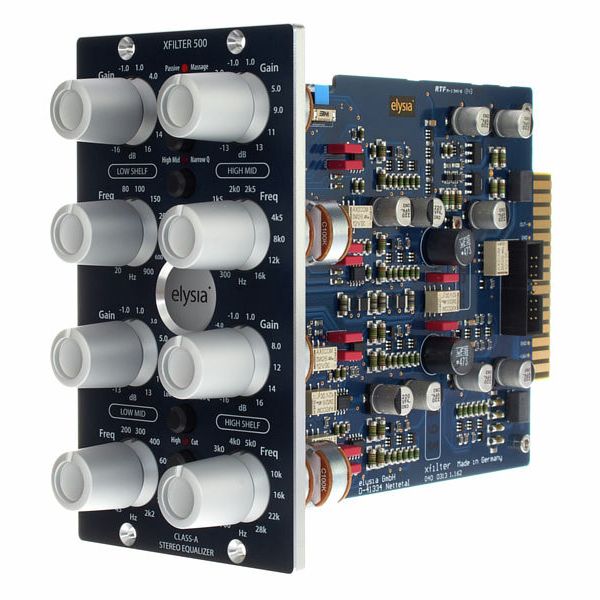
When we evaluate stereo EQs for pro audio, the Elysia Xfilter 500 stands out for its transparent class-A design, passive LC circuitry, and true stereo operation. Its 4-band structure, with parametric mids and stepped controls, offers precise tonal shaping and recall.
But how does it really perform compared to other high-end 500-series EQs, and is its sound as refined as its specs suggest? Let’s break down what sets it apart.

What Makes the Elysia Xfilter 500 Unique?
While many 500 series equalizers offer basic parametric controls, the Elysia Xfilter 500 distinguishes itself with its true stereo operation and fully discrete class-A topology.
We immediately notice the advantage of a stereo EQ that isn’t just dual-mono. Here, every control is precisely matched, ensuring perfect imaging and phase coherence. Unlike typical 500 series units, the Xfilter 500 delivers a linked stereo EQ experience, ideal for mix bus or stereo instrument processing.
Elysia’s circuit design incorporates a passive LC filter network for the high and low bands, a technique that delivers smoother curves and a musical resonance peak, without harshness or phase distortion.
When comparing it against competitors, few offer this blend of passive LC warmth, true stereo accuracy, and innovative audio transparency in a single module.
Key Features and Controls of the Xfilter 500
Given its innovative design, the Xfilter 500’s controls provide an intuitive yet highly flexible workflow that appeals to both seasoned engineers and perceptive producers.
We immediately notice its true stereo equalizer operation; every knob precisely matches both channels, ensuring consistent results.
The 4-band architecture includes two parametric mid bands, each with a wide frequency range, allowing surgical or musical adjustments.
High and low bands operate as shelving filters, offering smooth tone shaping at the spectrum’s extremes.
Each band features a dedicated knob for gain and frequency selection, granting us tactile, rapid access to subtle EQ decisions.
Compared to other 500-series EQs, the Xfilter 500’s combination of stepped controls and relay-based hard bypass delivers recall precision and transparency, making it a standout for innovative workflows.
How Does the Xfilter 500 Sound in Practice?
Once we route audio through the Xfilter 500, its sonic character becomes immediately apparent: the equalizer imparts a refined clarity and open top end that distinguishes it from many 500-series competitors. We notice its stereo EQ design maintains perfect channel tracking, yielding a cohesive stereo image that feels expansive yet precisely focused.
The analog circuitry delivers a clean and punchy character, especially evident when we push the low-mids or accentuate the high frequency range, transient projection and solid punch both shine without harshness or smear.
- Crystal-clear top end enhances detail without introducing brittleness
- Tight low frequencies retain definition, adding weight and authority
- Stereo image feels natural, with excellent left-right coherence
- Analog warmth coexists with modern transparency and precision
In practice, the Xfilter 500 rewards innovative mixing with unmistakable sonic polish.
Xfilter 500 Pros and Cons
Although the Xfilter 500 stands out in the crowded 500-series EQ market, it’s important to weigh its distinct advantages against a few remarkable limitations. We appreciate the true stereo eq architecture which rare in the 500 series format, that allows us to process stereo signals with perfect channel matching.
The analog stereo equalizer delivers musicality and precision, and the filters with resonance add a dimension not found in most competitors. Being linked for stereo operation ensures workflow efficiency and sonic consistency.
However, there are limitations: the lack of independent left/right control may frustrate those seeking advanced stereo sculpting. The fixed Q and overlap between mid bands can also restrict detailed frequency carving.
Still, for those prioritizing analog clarity and innovation, the Xfilter 500 is compelling.
Xfilter 500 Vs Other 500-Series EQS
While the 500-series EQ terrain offers a wide array of choices, the Elysia Xfilter 500 distinguishes itself through its true stereo signal path, an uncommon feature among its peers. When comparing the xfilter 500 stereo eq to other 500 series eqs, we immediately notice its seamless stereo operation, eliminating the need to match dual mono units.
Technically, the xfilter’s precision in its parametric mid bands stands out, providing surgical yet musical control that’s rarely matched in this format. Many competing EQs lack the xfilter’s transparent circuitry and recallable settings.
- True stereo operation, unlike most 500 series eq designs
- Matched parametric mid bands for accurate left-right consistency
- Transparent analog path, ideal for mastering and buses
- Intuitive controls streamline workflow over dual-mono alternatives
For innovation-driven workflows, these differences matter.
- 500 Series 4-band stereo EQ module
- High and low shelf band options that can be switched into high-cut and low-cut filters
- 2 mid-peak filters with switchable (wide or narrow) Q factor
- Unique switchable fixed Passive Massage LC filter for polishing the HF range
- 100% discrete Class A circuitry and computer-selected components for for boutique sound quality
Why You Need The Xfilter 500?
Given the myriad options in the 500-series EQ terrain, we need to reflect on what sets the Elysia Xfilter 500 apart when deciding if it deserves a place in our racks.
The Xfilter 500 offers true stereo EQ processing, which is rare in the 500 series format and essential for those of us demanding precise stereo image retention. Its passive massage feature delivers a smooth top end without introducing harsh resonance, giving mixes clarity and depth.
Compared to other stereo EQs, the elysia xfilter 500’s transparency and innovative filter curves stand out. If we’re after a flexible, musical tool that handles detailed equalization with surgical accuracy, the Xfilter 500 is a serious contender.
For innovation-minded engineers, it’s an investment worth considering.
Frequently Asked Questions
Q: Why is recall so difficult with the xfilter 500?
A: So, what makes recalling settings on the xfilter 500 such a challenge? We quickly notice that the user interface, while sleek, doesn’t offer visual feedback or digital readouts, everything relies on analog positions.
Without built-in sensor calibration, every tweak becomes a guessing game. For those of us who crave precision and repeatability in our workflow, this old-school approach limits the innovative spirit we’re after.
Q: Are the knob detents oddly placed?
Although detents usually help us dial in settings with confidence, the ones on the xfilter 500 can feel strangely inconsistent. We notice some steps line up intuitively, but others disrupt our workflow, making precise adjustments less fluid than we’d expect from such a forward-thinking unit.
Despite the impressive ergonomic design and undeniable aesthetic appeal, the detent placement could benefit from a rethink to better match creative demands.
Q: Is the xfilter 500 too bright when driven hard?
When we really push the xfilter 500, its high end becomes noticeably pronounced, sometimes bordering on excessive brightness. This shift in color temperature offers a modern edge.
But we find it can introduce a sharp sound coloration that’s not always welcome in every mix. For those chasing innovative tones, this brightness can be a creative tool, though it demands careful balancing to avoid harshness.
Q: Are there gain staging and distortion issues I should know about?
While dialing in the Elysia xfilter 500, we’ve noticed it responds sensitively to gain staging, and improper levels can introduce unwanted distortion. We need to watch for gain issues, especially when stacking multiple sources.
If we’re pushing for innovative sound shaping, it’s essential to monitor input and output levels. Otherwise, distortion concerns may quickly arise, affecting the clarity and integrity of our creative processing chain.
Q: Is it hard to dial in small changes?
Even with its clean layout and smooth controls, we find that dialing in subtle adjustments on the Elysia xfilter 500 feels remarkably straightforward. The user interface design truly supports fine tuning precision, letting us make micro-adjustments without frustration.
For those focused on innovation and detail, the tactile feedback and intuitive knob response inspire confidence, making it easy to achieve subtle results in any creative or technical scenario.
Q: Can you tell if knobs are at 0 or slightly +/-?
After appreciating how easily we can make precise tweaks on the xfilter 500, our attention naturally shifts to the visual feedback from the knobs themselves. The user interface offers clear markings, so identifying if we’re exactly at 0 or just slightly +/- is straightforward.
Elysia’s knob calibration is impressively accurate, allowing us to trust our adjustments. A feature that truly supports workflow innovation in fast-paced studio environments.
Q: Is there no controllable Q factor?
Although the xfilter 500 impresses with its intuitive controls, we quickly notice that it doesn’t offer a variable Q factor. For those of us seeking a controllable Q for surgical precision or creative filter resonance, this limitation stands out.
The fixed Q design means we can’t dial in sharper or broader boosts and cuts, which might leave some innovators wishing for deeper sound-shaping flexibility.
Q: Why does it take up two 500-series spaces?
When we slot the xfilter 500 into our rack, we immediately notice it claims two spaces instead of one. That’s a bold move, but it’s not just for show.
Elysia’s innovative circuit design demands more real estate for best power consumption and signal integrity.
Plus, the aesthetic design is sleek and intentional, allowing intuitive control placement without crowding, which aligns perfectly with a forward-thinking workflow.
Q: Are all controls stereo-linked only?
So, do all the controls on the xfilter 500 operate in stereo only? Yes, every parameter is stereo-linked by design, ensuring that both channels remain perfectly matched.
While this approach maximizes phase coherence and workflow efficiency, it means we don’t get control independence for left and right channels.
For those of us seeking absolute precision and innovation in stereo processing, this stereo linking is a purposeful, forward-thinking feature.
Conclusion
In the crowded sea of 500-series EQs, the Elysia Xfilter 500 stands as a lighthouse, guiding our mixes with clarity and precision. Its discrete class-A design and stepped controls offer both color and consistency, while the true stereo path guarantees our imaging stays razor-sharp.
Compared to its peers, the Xfilter 500 delivers a blend of musicality and technical excellence that’s hard to beat. For those seeking surgical shaping without sacrificing soul, this EQ is a wise investment.